




Abbas Mezaal Karafe1, Omar A. Alwash1, Khazaal Hameed Khazaal1, Hayder Meteab Mohsin1, Safa Al-deen A. Juboori1, and M. J. Aljumaili2
1Scientific Research Commission, Baghdad, Iraq
2Biomedical Engineering Research Center, University of Anbar, Anbar, Iraq
Received: March 30, 2026
Accepted: July 29, 2026
Publication Date: October 09, 2026
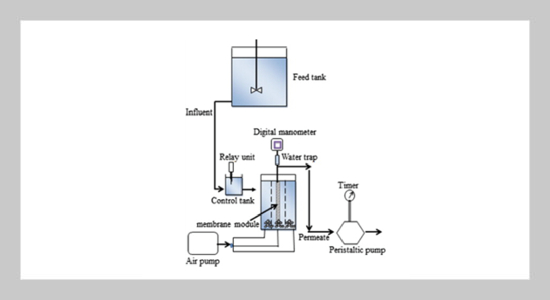
The MBR system represented schematically
Copyright The Author(s). This is an open access article distributed under the terms of the Creative Commons Attribution License (CC BY 4.0), which permits unrestricted use, distribution, and reproduction in any medium, provided the original author and source are cited.
Download Citation: BibTeX | http://dx.doi.org/10.6180/jase.202701_36.012
An oily effluent from the Al-Dora petroleum refinery in Baghdad, Iraq, was investigated to evaluate the performance of a membrane bioreactor (MBR) under various operating conditions. The system was operated at hydraulic retention times (HRTs) ranging from 12 to 24 hours, with mixed liquor suspended solids (MLSS) concentrations of 6.8 and 8.7 g/L. Evolutionary polynomial regression (EPR) was employed to integrate several kinetic models, including first-order, modified Stover-Kincannon, and Grau second-order models, to predict and interpret bioreactor performance. Experimental results showed that at an MLSS concentration of 8.7 g/L and an HRT of 24 hours, the chemical oxygen demand (COD) removal efficiency reached approximately 96.4%. Overall, the findings demonstrated that higher MLSS concentrations and longer HRTs positively influenced the organic removal efficiency of the MBR system. The EPR model exhibited high predictive accuracy, confirming its effectiveness in describing the nonlinear behavior of MBRs treating refinery effluent. Optimization analysis based on EPR modeling identified optimal operating conditions at an HRT of approximately 21 hours and an MLSS concentration of about 8.3 g/L. Furthermore, kinetic evaluation revealed that the modified Stover-Kincannon and Grau second-order models provided a more realistic representation of COD removal behavior within the investigated operating range, outperforming the first-order kinetic model.
Keywords: Membrane bioreactor (MBR), Oily wastewater treatment, Petroleum refinery effluent, Chemical oxygen demand (COD) removal, Mixed liquor suspended solids (MLSS)
- [1] E. Ntagia, E. Fiset, L. T. C. Hong, E. Vaiopoulou, and K. Rabaey, (2020) “Electrochemical treatment of industrial sulfidic spent caustic streams for sulfide removal and caustic recovery” Journal of Hazardous Materials 388: 121770. DOI: https://doi.org/10.1016/j.jhazmat.2019.121770.
- [2] B. Singh and P. Kumar, (2020) “Pre-treatment of petroleum refinery wastewater by coagulation and flocculation using mixed coagulant: Optimization of process parameters using response surface methodology” Journal of Water Process Engineering 36: 101317. DOI: https://doi.org/10.1016/j.jwpe.2020.101317.
- [3] M. G. Chesnokova, V. V. Shalay, A. S. Kriga, and A. P. Shaporenko, (2017) “The flocculants applied in the oil refining plant wastewater treatment” AIP Conference Proceedings 1876(1): 020017. DOI: https://doi.org/10.1063/1.4998837.
- [4] P. B. Moser, B. C. Ricci, B. G. Reis, L. S. Neta, A. C. Cerqueira, and M. C. Amaral, (2018) “Effect of MBR-H2O2/UV hybrid pre-treatment on nanofiltration performance for the treatment of petroleum refinery wastewater” Separation and Purification Technology 192: 176-184. DOI: https://doi.org/10.1016/j.seppur.2017.09.070.
- [5] A. Behnami, D. Farajzadeh, S. Isazadeh, K. Z. Benis, M. Shakerkhatibi, Z. Shiri, S. Ghorghanlu, and A. Yadeghari, (2018) “Diversity of bacteria in a full-scale petrochemical wastewater treatment plant experiencing stable hydrocarbon removal” Journal of Water Process Engineering 23: 285-291. DOI: https://doi.org/10.1016/j.jwpe.2018.04.015.
- [6] T. Shahriari, A. R. Karbassi, and M. Reyhani, (2019) “Treatment of oil refinery wastewater by electrocoagulation-flocculation (case study: Shazand Oil Refinery of Arak)” International Journal of Environmental Science and Technology 16(8): 4159-4166. DOI: https://doi.org/10.1007/s13762-018-1810-z.
- [7] A. Khalidi-Idrissi, O. Hartal, A. Madinzi, K. El-Abbadi, and S. Souabi, (2025) “Natural flotation and coagulation-flocculation: A dual approach to refinery wastewater treatment” Euro-Mediterranean Journal for Environmental Integration 10(3): 1425-1443. DOI: https://doi.org/10.1007/s41207-024-00558-4.
- [8] G. Louhichi, L. Bousselmi, A. Ghrabi, and I. Khouni, (2019) “Process optimization via response surface methodology in the physico-chemical treatment of vegetable oil refinery wastewater” Environmental Science and Pollution Research 26(19): 18993-19011. DOI: https://doi.org/10.1007/s11356-018-2657-z.
- [9] N. N. Ayhan, A. Aldemir, and A. Özgüven, (2024) “Treatment of petroleum refinery wastewater by chemical coagulation method: Determination of optimum removal conditions using experimental design” Brazilian Journal of Chemical Engineering 41(1): 121-137. DOI: https://doi.org/10.1007/s43153-023-00358-3.
- [10] K. Gurung, M. C. Ncibi, and M. Sillanpää, (2017) “Assessing membrane fouling and the performance of pilot-scale membrane bioreactor (MBR) to treat real municipal wastewater during winter season in Nordic regions” Science of the Total Environment 579: 1289-1297. DOI: https://doi.org/10.1016/j.scitotenv.2016.11.122.
- [11] I. Khouni, G. Louhichi, A. Ghrabi, and P. Moulin, (2020) “Efficiency of a coagulation/flocculation-membrane filtration hybrid process for the treatment of vegetable oil refinery wastewater for safe reuse and recovery” Process Safety and Environmental Protection 135: 323-341. DOI: https://doi.org/10.1016/j.psep.2020.01.004.
- [12] S. Zueva, V. Corradini, E. Ruduka, and F. Veglio, (2020) “Treatment of petroleum refinery wastewater by physicochemical methods” E3S Web of Conferences 161: 01042. DOI: https://doi.org/10.1051/e3sconf/202016101042.
- [13] Z. You, H. Xu, Y. Sun, S. Zhang, and L. Zhang, (2018) “Effective treatment of emulsified oil wastewater by coagulation-flotation” RSC Advances 8: 40639-40646. DOI: https://doi.org/10.1039/C8RA06565A.
- [14] M. S. Lawan, R. Kumar, J. Rashid, and M. A. E. F. Barakat, (2023) “Recent advancements in petroleum refinery wastewater treatment” Water 15(20): 3676. DOI: https://doi.org/10.3390/w15203676.
- [15] Y. Sun, Y. Liu, J. Chen, Y. Huang, H. Lu, W. Yuan, and H. Wang, (2021) “Physical pretreatment of petroleum refinery wastewater for oil and solids removal” Journal of Cleaner Production 278: 123821. DOI: https://doi.org/10.1016/j.jclepro.2020.123821.
- [16] P. Krzeminski, L. Leverette, S. Malamis, and E. Katsou, (2017) “Membrane bioreactors a review on recent developments in energy reduction, fouling control, novel configurations, LCA and market prospects” Journal of Membrane Science 527: 207-227. DOI: https://doi.org/10.1016/j.memsci.2016.12.010.
- [17] C. Haddaji, K. Ennaciri, A. Driouich, K. Digua, and S. Souabi, (2022) “Optimization of coagulation-flocculation for vegetable oil refinery wastewater” Process Safety and Environmental Protection 160: 803-816. DOI: https://doi.org/10.1016/j.psep.2022.02.068.
- [18] S. Putatunda, S. Bhattacharya, D. A. D. G. Sen, and C. Bhattacharjee, (2019) “A review on the application of different treatment processes for emulsified oily wastewater” International Journal of Environmental Science and Technology 16(5): 2525-2536. DOI: https://doi.org/10.1007/s13762-018-2055-6.
- [19] H. A. Jabbar and M. J. Alatabe, (2021) “Coagulation/flocculation process for oily wastewater treatment” Journal of Engineering and Sustainable Development 25(Special Issue): 3-68-3-76. DOI: https://doi.org/10.31272/jeasd.conf.2.3.6.
- [20] G. Kang and Y. Cao, (2014) “Application and modification of PVDF membranes: A review” Journal of Membrane Science 463: 145-165. DOI: https://doi.org/10.1016/j.memsci.2014.03.055.
- [21] B. Hudaib, R. Abu-Zurayk, H. Waleed, and A. A. Ibrahim, (2022) “Fabrication of PVDF/MWCNT/polypyrrole ultrafiltration membrane for oily wastewater” Membranes 12(8): 751. DOI: https://doi.org/10.3390/membranes12080751.
- [22] S. Pahlavanzadeh, K. Z. Benis, M. Shakerkhatibi, A. K. Jashni, N. T. Beydokhti, and S. A. Kordkandi, (2018) “Performance of an aerated submerged fixed-film bioreactor” Journal of Environmental Chemical Engineering 6(5): 6154-6164. DOI: https://doi.org/10.1016/j.jece.2018.09.045.
- [23] H. Abyar, H. Younesi, N. Bahramifar, A. A. Zinatizadeh, and M. Amini, (2017) “Kinetic evaluation of COD and nitrogen removal in UAASB” Journal of the Taiwan Institute of Chemical Engineers 78: 272-281. DOI: https://doi.org/10.1016/j.jtice.2017.06.014.
- [24] A. Behnami, K. Z. Benis, M. Shakerkhatibi, E. Fatehifar, S. Derafshi, and M. M. Chavoshbashi, (2019) “Integrating data reconciliation into material flow cost accounting: The case of a petrochemical wastewater treatment plant” Journal of Cleaner Production 218: 616-628. DOI: https://doi.org/10.1016/j.jclepro.2019.01.218.
- [25] K. Valizadeh, A. Heydarinasab, S. S. Hosseini, and S. Bazgir, (2021) “Preparation of modified membrane of polyvinylidene fluoride (PVDF) and evaluation of anti-fouling features and high capability in water/oil emulsion separation” Journal of the Taiwan Institute of Chemical Engineers 126: 36-49. DOI: https://doi.org/10.1016/j.jtice.2021.07.018.
- [26] Y. Sun, Y. Lin, L. Fang, L. Zhang, L. Cheng, T. Yoshioka, and H. Matsuyama, (2019) “Facile development of poly(tetrafluoride ethylene-r-vinylpyrrolidone) modified PVDF membrane with comprehensive antifouling property for highly efficient challenging oil-in-water emulsions separation” Journal of Membrane Science 584: 161-172. DOI: https://doi.org/10.1016/j.memsci.2019.04.071.
- [27] Z. Derakhshan, M. H. Ehrampoush, A. H. Mahvi, M. T. Ghaneian, S. M. Mazloomi, and M. Faramarzian, (2018) “Biodegradation of atrazine in a moving bed biofilm reactor” Journal of Environmental Management 212: 506-513. DOI: https://doi.org/10.1016/j.jenvman.2018.02.043.
- [28] Z. Xu, L. Qi, S. Wang, G. Xing, W. Wang, and Z. Liu, (2025) “The preparation of electrospun PVDF membranes and their applications in the removal of dyes, heavy metals and oil-water separation” Chemical Engineering Science 318: 122182. DOI: https://doi.org/10.1016/j.ces.2025.122182.
- [29] T. El-Badawy, M. H. D. Othman, M. R. Adam, R. Kamaludin, A. F. Ismail, M. A. Rahman, and H. Abdullah, (2022) “Braid-reinforced PVDF hollow fiber membranes for oily wastewater” Journal of Environmental Chemical Engineering 10(3): 107258. DOI: https://doi.org/10.1016/j.jece.2022.107258.
- [30] T. Sathish, R. Saravanan, and V. Vijayan, (2022) “Investigations on influences of MWCNT composite membranes in oil refineries wastewater treatment with Taguchi route” Chemosphere 298: 134265. DOI: https://doi.org/10.1016/j.chemosphere.2022.134265.
- [31] D. Zioui, H. Salazar, L. Aoudjit, P. M. Martins, and S. Lanceros-Méndez, (2020) “Polymer-based membranes for oily wastewater remediation” Polymers 12(1): 42. DOI: https://doi.org/10.3390/polym12010042.
- [32] L. Nie, X. Li, D. Li, J. Zhang, S. Long, Y. Huang, and X. Li, (2025) “Superhydrophilic, multi-level antifouling PVDF microfiltration membrane with ionically crosslinked “organic-inorganic” bridging in oily wastewater treatment” Chemical Engineering Journal 524: 169162. DOI: https://doi.org/10.1016/j.cej.2025.169162.
- [33] E. Yuliwati, A. F. Ismail, M. H. D. Othman, and M. M. A. Shirazi, (2022) “Critical flux and fouling analysis of PVDF-mixed matrix membranes for reclamation of refinery-produced wastewater: Effect of mixed liquor suspended solids concentration and aeration” Membranes 12(2): 161. DOI: https://doi.org/10.3390/membranes12020161.
- [34] S. A. Yousefi, M. S. Nasser, I. A. Hussein, A. Benamor, and M. H. El-Naas, (2020) “Influence of polyelectrolyte structure and type on the degree of flocculation and rheological behavior of industrial MBR sludge” Separation and Purification Technology 233: 116001. DOI: https://doi.org/10.1016/j.seppur.2019.116001.
- [35] J. Ahmadi, D. Kahforoushan, E. Fatehifar, K. Z. Benis, and M. Nadjafi, (2016) “Drying of Urmia Lake: Modeling of level fluctuations” Environmental Health Engineering and Management Journal 3(1): 23-28.
- [36] Y. Li, Z. Song, Y. Yuan, Q. Zhang, and H. Zhu, (2020) “Rheology improvement in osmotic membrane bioreactors” Bioresource Technology 295: 122313. DOI: https://doi.org/10.1016/j.biortech.2019.122313.
- [37] M. Ruiz-Hernando, S. Vinardell, J. Labanda, and J. Llorens, (2022) “Effect of ultrasonication on sludge rheology and economics” Water Research 208: 117855. DOI: https://doi.org/10.1016/j.watres.2021.117855.
- [38] U. M. Ismail, K. Bani-Melhem, M. F. Khan, and H. Elnakar, (2025) “Optimizing membrane bioreactor performance in wastewater treatment using machine learning and meta-heuristic techniques” Results in Engineering 25: 104626. DOI: https://doi.org/10.1016/j.rineng.2025.104626.
- [39] F. A. Oghyanous, H. Etemadi, R. Yegani, and B. Ghofrani, (2022) “Membrane fouling and removal performance of submerged aerobic membrane bioreactors: A comparative study of optimizing operational conditions and membrane modification” Journal of Chemical Technology and Biotechnology 97(5): 1190-1199. DOI: https://doi.org/10.1002/jctb.7004.
- [40] Y. Gao, Z. Fang, C. Chen, X. Zhu, P. Liang, Y. Qiu, X. Zhang, and X. Huang, (2020) “Evaluating the performance of inorganic draw solution concentrations in an anaerobic forward osmosis membrane bioreactor for real municipal sewage treatment” Bioresource Technology 307: 123254. DOI: https://doi.org/10.1016/j.biortech.2020.123254.
- [41] L. Shen, Q. Wu, Q. Ye, H. Lin, J. Zhang, C. Chen, and B. Q. Liao, (2023) “Superior performance of a membrane bioreactor through innovative in-situ aeration and structural optimization using computational fluid dynamics” Water Research 243: 120353. DOI: https://doi.org/10.1016/j.watres.2023.120353.
- [42] X. Y. Tang, W. W. Yang, X. Ma, and X. E. Cao, (2023) “An integrated modeling method for membrane reactors and optimization study of operating conditions” Energy 268: 126730. DOI: https://doi.org/10.1016/j.energy.2023.126730.
- [43] M. Shafiquzzaman, H. Haider, and A. K. M. Ashadullah, (2021) “Optimization of algal-based membrane bioreactor for greywater treatment” Process Safety and Environmental Protection 154: 81-88. DOI: https://doi.org/10.1016/j.psep.2021.08.007.
- [44] A. Black, K. Newhart, C. Linvill, A. Pytlar, S. Galaitsi, C. Fairfield, M. Wait, E. Bennett, M. Butkus, and A. R. Pfluger, (2025) “A linguistic analysis of energy terminology in the wastewater literature” Water Science and Technology 91(6): 671-683. DOI: https://doi.org/10.2166/wst.2025.036.
- [45] S. Waqas, N. Y. Harun, U. Arshad, A. M. Laziz, S. L. S. Mun, M. R. Bilad, and A. S. Alsaadi, (2024) “Optimization of membrane-RBC systems using RSM, ANN and SVM” Chemosphere 349: 140830. DOI: https://doi.org/10.1016/j.chemosphere.2023.140830.
- [46] L. Li, S. Suwanate, and C. Visvanathan, (2017) “Performance of attached-growth membrane bioreactor” Bioresource Technology 240: 3-8. DOI: https://doi.org/10.1016/j.biortech.2017.01.043.
- [47] F. Li, W. Kong, X. Zhao, and Y. Pan, (2020) “Multifunctional TiO2-based superoleophobic/superhydrophilic coating for oil-water separation and oil purification” ACS Applied Materials & Interfaces 12(15): 18074-18083. DOI: https://doi.org/10.1021/acsami.9b22625.
- [48] H. Kwon, Y. Park, S. Kim, H. Yun, and J. Bae, (2025) “Optimization of nitrogen removal through an intelligent automated operational strategy based on real-time process simulation in an A2O membrane bioreactor” Journal of Environmental Management 389: 126233. DOI: https://doi.org/10.1016/j.jenvman.2025.126233.
- [49] M. Nowrouzi and H. Abyar, (2021) “A framework for the design and optimization of integrated fixed-film activated sludge-membrane bioreactor configuration by focusing on cost-coupled life cycle assessment” Journal of Cleaner Production 296: 126557. DOI: https://doi.org/10.1016/j.jclepro.2021.126557.
- [50] W. Ji, Y. Xiao, F. Xiao, L. Li, M. Chen, and H. Wang, (2024) “A novel photocatalytic membrane for biochemical oily wastewater purification” Chemical Engineering Journal 493: 152759. DOI: https://doi.org/10.1016/j.cej.2024.152759.