




1College of Big Data and Artificial Intelligence, Zhengzhou University of Economics and Business, Zhengzhou 451191, China
2 Henan Province Engineering Research Center of Multimodal Perception and Intelligent Interaction Technology, Zhengzhou 451191, China
3 Zhengzhou Technical College, Zhengzhou 450100, China
Received: August 22, 2026
Accepted: September 08, 2026
Publication Date: October 09, 2026
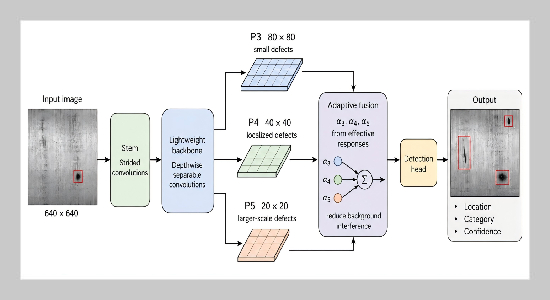
Architecture of the lightweight multiscale defect detector
Copyright The Author(s). This is an open access article distributed under the terms of the Creative Commons Attribution License (CC BY 4.0), which permits unrestricted use, distribution, and reproduction in any medium, provided the original author and source are cited.
Download Citation: BibTeX | http://dx.doi.org/10.6180/jase.202701_36.004
This study presents an online closed-loop quality-control method that integrates real-time computer vision with a digital twin. Rather than treating inspection and control as separate tasks, a lightweight multiscale detector converts bounding boxes into timestamped quality states used for next-cycle risk prediction and constrained parameter search. On the NEU test set, the detector reaches 94.1% mAP@0.5 and 63.8% mAP@0.5:0.95 at 78.6 FPS. The online-corrected twin predictor obtains an RMSE of 0.018 and R2 of 0.923. Under paired simulated disturbances, the complete loop reduces average defect rate from 7.82% to 2.94%, raises first-pass yield to 96.9%, and runs with an average latency of 34.8 ms. Representative images support the reported localization behavior for small, low-contrast defects. These results establish controlled-environment feasibility, not plant-wide generalization.
Keywords: Multiscale feature fusion, quality prediction, physical-virtual synchronization, online decision-making, closed-loop control
- [1] H. F. Le, L. J. Zhang, and Y. X. Liu, (2022) “Surface Defect Detection of Industrial Parts Based on YOLOV5” IEEE Access 10: 130784-130794. DOI: https://doi.org/10.1109/ACCESS.2022.3228687.
- [2] X. Qian, X. Wang, S. Yang, and J. Lei, (2022) “LFF-YOLO: A YOLO Algorithm with Lightweight Feature Fusion Network for Multi-Scale Defect Detection” IEEE Access 10: 130339-130349. DOI: https://doi.org/10.1109/ACCESS.2022.3227205.
- [3] Y. Li, S. Xu, Z. Zhu, P. Wang, K. Li, Q. He, and Q. Zheng, (2023) “EFC-YOLO: An Efficient Surface-Defect-Detection Algorithm for Steel Strips” Sensors 23(17): 7619. DOI: https://doi.org/10.3390/s23177619.
- [4] Z. Yu, Y. Wu, B. Wei, Z. Ding, and F. Luo, (2023) “A Lightweight and Efficient Model for Surface Tiny Defect Detection” Applied Intelligence 53(6): 6344-6353. DOI: https://doi.org/10.1007/s10489-022-03633-x.
- [5] J. Lu, M. Yu, and J. Liu, (2024) “Lightweight Strip Steel Defect Detection Algorithm Based on Improved YOLOv7” Scientific Reports 14(1): 13267. DOI: https://doi.org/10.1038/s41598-024-64080-x.
- [6] S. Gao, M. Chu, and L. Zhang, (2024) “A Detection Network for Small Defects of Steel Surface Based on YOLOv7” Digital Signal Processing 149: 104484. DOI: https://doi.org/10.1016/j.dsp.2024.104484.
- [7] W. Chen, Z. Huang, Q. Mu, and Y. Sun, (2022) “PCB Defect Detection Method Based on Transformer-YOLO” IEEE Access 10: 129480-129489. DOI: https://doi.org/10.1109/ACCESS.2022.3228206.
- [8] Q. Wang, H. Dong, and H. Huang, (2024) “Swin-Transformer-YOLOv5 for Lightweight Hot-Rolled Steel Strips Surface Defect Detection Algorithm” PLOS ONE 19(1): e0292082. DOI: https://doi.org/10.1371/journal.pone.0292082.
- [9] C. Zhuang, Z. Liu, J. Liu, H. Ma, S. Zhai, and Y. Wu, (2022) “Digital Twin-Based Quality Management Method for the Assembly Process of Aerospace Products with the Grey-Markov Model and Apriori Algorithm” Chinese Journal of Mechanical Engineering 35(1): 105. DOI: https://doi.org/10.1186/s10033-022-00763-8.
- [10] L. Liu, X. Zhang, X. Wan, S. Zhou, and Z. Gao, (2022) “Digital Twin-Driven Surface Roughness Prediction and Process Parameter Adaptive Optimization” Advanced Engineering Informatics 51: 101470. DOI: https://doi.org/10.1016/j.aei.2021.101470.
- [11] Z. Zhao, S. Wang, Z. Wang, S. Wang, C. Ma, and B. Yang, (2022) “Surface Roughness Stabilization Method Based on Digital Twin-Driven Machining Parameters Self-Adaption Adjustment: A Case Study in Five-Axis Machining” Journal of Intelligent Manufacturing 33(4): 943-952. DOI: https://doi.org/10.1007/s10845-020-01698-4.
- [12] M. Perno, L. Hvam, and A. Haug, (2023) “A Machine Learning Digital Twin Approach for Critical Process Parameter Prediction in a Catalyst Manufacturing Line” Computers in Industry 151: 103987. DOI: https://doi.org/10.1016/j.compind.2023.103987.
- [13] Y. Wang, F. Tao, Y. Zuo, M. Zhang, and Q. Qi, (2023) “Digital-Twin-Enhanced Quality Prediction for the Composite Materials” Engineering 22: 23-33. DOI: https://doi.org/10.1016/j.eng.2022.08.019.
- [14] Y. Zuo, H. You, X. Zou, W. Ji, and F. Tao, (2024) “Digital Twin Enhanced Quality Prediction Method of Powder Compaction Process” Robotics and Computer-Integrated Manufacturing 89: 102762. DOI: https://doi.org/10.1016/j.rcim.2024.102762.
- [15] S. Liu, J. Bao, and P. Zheng, (2023) “A Review of Digital Twin-Driven Machining: From Digitization to Intellectualization” Journal of Manufacturing Systems 67: 361-378. DOI: https://doi.org/10.1016/j.jmsy.2023.02.010.