


Received: March 23, 2026
Accepted: July. 06, 2026
Publication Date: September 16, 2026
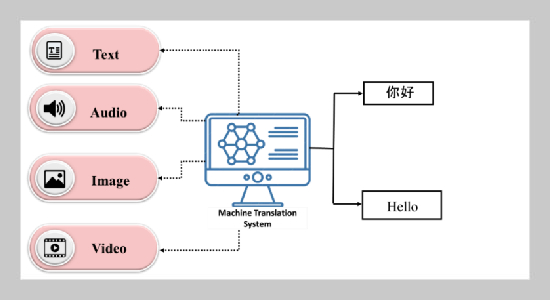
AI-based English translation workflow with multi-modal inputs and processing stages
Copyright The Author(s). This is an open access article distributed under the terms of the Creative Commons Attribution License (CC BY 4.0), which permits unrestricted use, distribution, and reproduction in any medium, provided the original author and source are cited.
Download Citation: BibTeX | http://dx.doi.org/10.6180/jase.202612_35.044
Artificial intelligence (AI)-based English translation systems using large language models enhance translation accuracy but rely heavily on large datasets, making them prone to bias and challenges in handling subtle linguistic contexts[cite: 7]. This study incorporates advanced AI techniques to improve the precision, accuracy, and overall performance of English translation systems in addressing linguistic issues[cite: 7]. A Scalable Sailfish-tuned Adaptive Gated Recurrent Unit (SS-AGRU) model is proposed to maximize translation accuracy while improving adaptability and efficiency[cite: 7]. The dataset consists of multilingual parallel data containing diverse sentence structures, idiomatic expressions, and domain-specific content to enable robust model training[cite: 7]. Preprocessing includes handling missing data, stopword removal, and tokenization to normalize text[cite: 7]. Word2Vec is employed to capture semantic relationships, while TF-IDF highlights term importance, enhancing input quality and model performance[cite: 7]. The proposed approach integrates AGRU with an optimized Scalable Sailfish (SS) algorithm, improving sequence processing, contextual understanding, parameter optimization, and computational efficiency[cite: 7]. Experimental results demonstrate strong performance, achieving a BLEU score of 50.12, translation time of 38.7 minutes, low TER of 0.337, and WER of 8.89[cite: 7]. The SS-AGRU model outperforms baseline methods in translation accuracy, contextual comprehension, and computational efficiency[cite: 7]. Overall, combining SS-AGRU with the optimized SS algorithm significantly enhances accuracy, flexibility, and computational performance in AI-based language translation systems[cite: 7].
Keywords: English translation, AI, Large language models, Scalable Sailfish Algorithm-tuned Adaptable Gated Recurrent Unit (SS-AGRU)
- [1] N. A. Mohamed, M. A. Zulkifley, A. A. Ibrahim, and M. Aouache, (2021) “Optimal Training Configurations of a CNN-LSTM-Based Tracker for a Fall Frame Detection System” Sensors 21(19): 6485. DOI: 10.3390/s21196485.
- [2] A. K. Mandal, R. Sen, S. Goswami, and B. Chakraborty, (2021) “Comparative Study of Univariate and Multivariate Long Short-Term Memory for Very Short-Term Forecasting of Global Horizontal Irradiance” Symmetry 13(8): 1544. DOI: 10.3390/sym13081544.
- [3] E. Kasneci, K. Sessler, S. Küchemann, M. Bannert, D. Dementieva, F. Fischer, U. Gasser, G. Groh, S. Günnemann, E. Hüllermeier, and S. Krusche, (2023) “ChatGPT for Good? On Opportunities and Challenges of Large Language Models for Education” Learning and Individual Differences 103: 102274. DOI: 10.1016/j.lindif.2023.102274.
- [4] C. Su, H. Huang, S. Shi, P. Jian, and X. Shi, (2020) “Neural Machine Translation with Gumbel Tree-LSTM Based Encoder” Journal of Visual Communication and Image Representation 71: 102811. DOI: 10.1016/j.jvcir.2020.102811.
- [5] J. Wang, J. Zhu, and Z. Yu, (2021) “Person Re-Identification Based on Attention Clustering and Long Short-Term Memory Network” Journal of Electronic Imaging 30(3): 033014. DOI: 10.1117/1.JEI.30.3.033014.
- [6] Q. Fang, (2025) “Terminology Alignment Based on Multi-level Feature Fusion for Japanese Scientific and Technological Literature Terminology Translation” Journal of Applied Science and Engineering 29(2): 465-473. DOI: 10.6180/jase.202602_29(2).0021.
- [7] P. K. Nagaraj, K. S. Ravikumar, M. S. Kasyap, M. H. S. Murthy, and J. Paul, (2021) “Kannada to English Machine Translation Using Deep Neural Network” Ingénierie des Systèmes d’Information 26(1): 123-127. DOI: 10.18280/isi.260113.
- [8] J. Son and B. Kim, (2023) “Translation Performance from the User’s Perspective of Large Language Models and Neural Machine Translation Systems” Information 14(10): 574. DOI: 10.3390/info1410574.
- [9] C. Wang, (2022) “AI-Based Heterogenous Large-Scale English Translation Strategy” Mobile Information Systems 2022(1): 8344814. DOI: 10.1155/2022/8344814.
- [10] X. Guo, (2022) “Optimization of English Machine Translation by Deep Neural Network under Artificial Intelligence” Computational Intelligence and Neuroscience 2022(1): 2003411. DOI: 10.1155/2022/2003411.
- [11] X. Han, (2024) “Analyzing the Impact of Deep Learning Algorithms and Fuzzy Logic Approach for Remote English Translation” Scientific Reports 14(1): 14556. DOI: 10.1038/s41598-024-64831-w.
- [12] X. Li, (2024) “Comparison of Translation Quality between Large Language Models and Neural Machine Translation Systems: A Case Study of Chinese-English Language Pair” International Journal of Education and Humanities 4(2): 121-128. DOI: 10.58557/ijeh.v4i2.213.
- [13] K. C. Lion, Y. H. Lin, and T. Kim, (2024) “Artificial Intelligence for Language Translation: The Equity Is in the Details” JAMA 332(17): 1427-1428. DOI: 10.1001/jama.2024.15296.
- [14] L. Zhou, (2023) “English-Chinese Corpus Collection and Artificial Intelligence Translation Based on Dynamic Clustering Model” International Journal of Science and Engineering Applications 12(2): 63-69. DOI: 10.7753/IJSEA1202.1029.
- [15] P. Alagarsundaram, (2023) “AI-Powered Data Processing for Advanced Case Investigation Technology” Journal of Science and Technology 8(8): 18-34. DOI: 10.46243/jst.2023.v8.108.pp18-34.
- [16] Nexdata. Chinese-English Parallel Corpus Data. 2023. URL: https://www.kaggle.com/datasets/nexdatafrank/chinese-english-parallel-corpus-data.
- [17] H. Israr, S. A. Khan, M. A. Tahir, M. K. Shahzad, M. Ahmad, and J. M. Zain, (2023) “Neural Machine Translation Models with Attention-Based Dropout Layer” CMC-Computers, Materials & Continua 75(2): 2982. DOI: 10.32604/cmc.2023.035814.