




Lin Jun1, Zhang Zhiguo2, Zhang Hua1
1The First Affiliated Hospital of Wenzhou Medical University; Wenzhou City, Zhejiang Province, 325000, China
2China Construction Third Engineering Group Co., Ltd., Wuhan City, Hubei Province, 430000, China
Received: June 9, 2026
Accepted: August 17, 2026
Publication Date: September 13, 2026
Construction Of A Precise Prediction Model For Hospital Power Distribution Load Based On Deep Learning LSTM Algorithm
Copyright The Author(s). This is an open access article distributed under the terms of the Creative Commons Attribution License (CC BY 4.0), which permits unrestricted use, distribution, and reproduction in any medium, provided the original author and source are cited.
Download Citation: BibTeX | http://dx.doi.org/10.6180/jase.202612_35.037
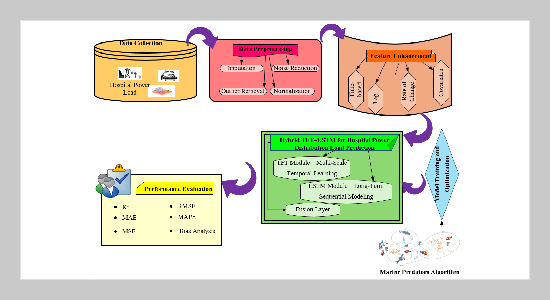
Accurate and reliable forecasting of the hospital power distribution load ensures all operations, including life-support systems, medical equipment, and environmental controls, continue unabated. Traditional forecasting methods like Autoregressive Integrated Moving Average (ARIMA), Seasonal Autoregressive Integrated Moving Average (SARIMA), and classic machine learning models are unable to deal with nonlinearities, sudden demand shifts, and complex temporal dependencies, limiting their usability in highly dynamic hospital settings. This study presents a Hybrid Temporal Fusion Transformer-Long Short-Term Memory (TFT-LSTM) framework optimized with the Marine Predators Algorithm (MPA) to solve the problems. The hospital load data with environmental and operational covariates undergo preprocessing, including imputation, outlier removal, and normalization. Feature engineering with time-dependent, lag, rate-of-change, and external covariate features further enhances the dataset. In the next step, the TFT module learns multi-scale temporal dependencies with interpretability through attention and variable selection mechanisms. Experimental results suggest the superiority of the proposed model achieving R²=0.957, MAE=33.80 kW, MSE=1921.27, RMSE=43.83, MSLE=0.0015, and MAPE=3.0%.
Keywords: Hospital power distribution load, Load forecasting, Long Short-Term Memory, Temporal Fusion Transformer, Hybrid deep learning.
- [1] A. B. A. Ferreira, J. B. Leite, and D. H. P. Salvadeo, (2025) “Power substation load forecasting using interpretable transformer-based temporal fusion neural networks” Electric Power Systems Research 238: 111169. DOI: https://doi.org/10.1016/j.epsr.2024.111169.
- [2] X. Wen, J. Liao, Q. Niu, N. Shen, and Y. Bao, (2024) “Deep learning-driven hybrid model for short-term load forecasting and smart grid information management” Scientific Reports 14(1): 13720. DOI: https://doi.org/10.1038/s41598-024-63262-x.
- [3] A. Unlu and M. Peña, (2025) “Comparative Analysis of Hybrid Deep Learning Models for Electricity Load Forecasting During Extreme Weather” Energies 18(12): 3068. DOI: https://doi.org/10.3390/en18123068.
- [4] M. A. Salman, M. A. Mahdi, and S. Al-Janabi, (2024) “A GMEE-WFED System: Optimizing Wind Turbine Distribution for Enhanced Renewable Energy Generation in the Future” International Journal of Computational Intelligence Systems 17(1): 5. DOI: https://doi.org/10.1007/s44196-023-00391-7.
- [5] T. Alquthami, M. Zulfiqar, M. Kamran, A. H. Milyani, and M. B. Rasheed, (2022) “A Performance Comparison of Machine Learning Algorithms for Load Forecasting in Smart Grid” IEEE Access 10: 48419-48433. DOI: https://doi.org/10.1109/ACCESS.2022.3171270.
- [6] R. I. Alkanhel, E.-S. M. El-Kenawy, M. M. Eid, L. Abualigah, and M. A. Saeed, (2024) “Optimizing IoT-driven smart grid stability prediction with dipper throated optimization algorithm for gradient boosting hyperparameters” Energy Reports 12: 305-320. DOI: https://doi.org/10.1016/j.egyr.2024.06.034.
- [7] F. M. Butt et al., (2022) “Intelligence based Accurate Medium and Long Term Load Forecasting System” Applied Artificial Intelligence 36(1): 2088452. DOI: https://doi.org/10.1080/08839514.2022.2088452.
- [8] B. Parizad, H. Ranjbarzadeh, A. Jamali, and H. Khayyam, (2024) “An Intelligent Hybrid Machine Learning Model for Sustainable Forecasting of Home Energy Demand and Electricity Price” Sustainability 16(6): 2328. DOI: https://doi.org/10.3390/su16062328.
- [9] Z. Chen, C. Wang, L. Lv, L. Fan, S. Wen, and Z. Xiang, (2023) “Research on Peak Load Prediction of Distribution Network Lines Based on Prophet-LSTM Model” Sustainability 15(15): 11667. DOI: https://doi.org/10.3390/su151511667.
- [10] S. Chaaraoui et al., (2021) “Day-Ahead Electric Load Forecast for a Ghanaian Health Facility Using Different Algorithms” Energies 14(2): 409. DOI: https://doi.org/10.3390/en14020409.
- [11] D. Fernández-Martínez and M. A. Jaramillo-Morán, (2022) “Multi-Step Hourly Power Consumption Forecasting in a Healthcare Building with Recurrent Neural Networks and Empirical Mode Decomposition” Sensors 22(10): 3664. DOI: https://doi.org/10.3390/s22103664.
- [12] A. Ajitha, M. Goel, M. Assudani, S. Radhika, and S. Goel, (2022) “Design and development of Residential Sector Load Prediction model during COVID-19 Pandemic using LSTM based RNN” Electric Power Systems Research 212: 108635. DOI: https://doi.org/10.1016/j.epsr.2022.108635.
- [13] S. Xiang, C. Zhen, J. Peng, L. Zhang, and Z. Pu, (2023) “Power load prediction of smart grid based on deep learning” Procedia Computer Science 228: 762-773. DOI: https://doi.org/10.1016/j.procs.2023.11.090.
- [14] K. Y. Chan, K. F. C. Yiu, D. Kim, and A. Abu-Siada, (2024) “Fuzzy Clustering-Based Deep Learning for Short-Term Load Forecasting in Power Grid Systems Using Time-Varying and Time-Invariant Features” Sensors 24(5): 1391. DOI: https://doi.org/10.3390/s24051391.
- [15] Shahid-Fakhri. Electricity-Consumption/README.md at main Shahid-Fakhri/Electricity-Consumption. GitHub. 2025. URL: https://github.com/Shahid-Fakhri/Electricity-Consumption/blob/main/README.md