




School of Journalism and Communications, Zhoukou Normal University, Zhoukou, 466000 Henan, China
Received: July 04, 2026
Accepted: September 29, 2026
Publication Date: September 11, 2026
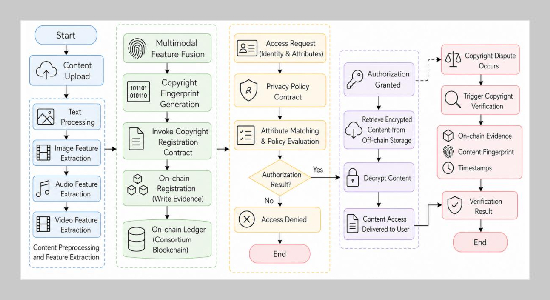
Operation Flow of the Proposed Model
Copyright The Author(s). This is an open access article distributed under the terms of the Creative Commons Attribution License (CC BY 4.0), which permits unrestricted use, distribution, and reproduction in any medium, provided the original author and source are cited.
Download Citation: BibTeX | http://dx.doi.org/10.6180/jase.202612_35.036
Industrial new media content such as equipment operation videos, technical manuals, engineering drawings, and factory livestreams faces growing copyright and privacy challenges from complex infringement methods, high on-chain storage pressure, and the risk of exposing creators’ identities and proprietary technical information. This study proposes a blockchain-based copyright and privacy protection model that ensures credible copyright evidence while preserving privacy and scalability. Built on a Hyperledger Fabric consortium blockchain, the model follows a layered “content processing-on-chain registration – privacy authorization – off-chain storage – copyright verification” architecture, integrating multimodal copyright fingerprinting, dynamic pseudo-identity generation, attribute-based access control with trust/risk/frequency scoring, hybrid on-chain-off-chain storage, and distributed indexing. Large-scale simulation with millions of content items shows a registration latency of 490 ms, throughput of 2120 TPS, retrieval response time of 430 ms, storage overhead of 280 GB, verification accuracy of 94.5%, and an F1 score of 0.76 under 50% tampering. The privacy leakage rate is reduced to 9.4%, with an 84.6% unauthorized-access interception rate under severe attack. These results indicate improved copyright robustness, stronger privacy protection, and better scalability, supporting staged deployment on consortium-based industrial new media platforms without exposing original content or real identities on-chain.
Keywords: Industrial new media content; Blockchain; Copyright protection; Privacy protection; Multimodal copyright fingerprint; Dynamic pseudo-identity.
- [1] X. Chen, A. Yang, J. Weng, Y. Tong, C. Huang, and T. Li, (2023) “A Blockchain-Based Copyright Protection Scheme with Proactive Defense” IEEE Transactions on Services Computing 16(4): 2316-2329. DOI: 10.1109/TSC.2023.3246476.
- [2] Y. Liu, J. Zhang, S. Wu, and M. S. Pathan, (2021) “Research on Digital Copyright Protection Based on the Hyperledger Fabric Blockchain Network Technology” PeerJ Computer Science 7: e709. DOI: 10.7717/peerj-cs.709.
- [3] R. F. Ciriello, A. C. G. Torbensen, M. R. P. Hansen, and C. Müller-Bloch, (2023) “Blockchain-Based Digital Rights Management Systems: Design Principles for the Music Industry” Electronic Markets 33(1): 1-21. DOI: 10.1007/s12525-023-00628-5.
- [4] W. Liang, D. Zhang, X. Lei, M. Tang, K.-C. Li, and A. Y. Zomaya, (2021) “Circuit Copyright Blockchain: Blockchain-Based Homomorphic Encryption for IP Circuit Protection” IEEE Transactions on Emerging Topics in Computing 9(3): 1410-1420. DOI: 10.1109/TETC.2020.2993032.
- [5] J. Han, Z. Li, J. Liu, H. Wang, M. Xian, Y. Zhang, and Y. Chen, (2022) “Attribute-Based Access Control Meets Blockchain-Enabled Searchable Encryption: A Flexible and Privacy-Preserving Framework for Multi-User Search” Electronics 11(16): DOI: 10.3390/electronics11162536.
- [6] Y. Zhang, M. Yutaka, M. Sasabe, and S. Kasahara, (2021) “Attribute-Based Access Control for Smart Cities: A Smart-Contract-Driven Framework” IEEE Internet of Things Journal 8(8): 6372-6384. DOI: 10.1109/JIOT.2020.3033434.
- [7] E. Chen, Y. Zhu, Z. Zhou, S.-Y. Lee, W. E. Wong, and W. C.-C. Chu, (2022) “Policychain: A Decentralized Authorization Service with Script-Driven Policy on Blockchain for Internet of Things” IEEE Internet of Things Journal 9(7): 5391-5409. DOI: 10.1109/JIOT.2021.3109147.
- [8] S. Ma and X. Zhang, (2024) “Integrating Blockchain and ZK-Rollup for Efficient Healthcare Data Privacy Protection System via IPFS” Scientific Reports 14: DOI: 10.1038/s41598-024-62292-9.
- [9] S. M. Darwish, M. M. Abu-Deif, and S. M. Elkaffas, (2024) “Blockchain for Video Watermarking: An Enhanced Copyright Protection Approach for Video Forensics Based on Perceptual Hash Function” PLOS ONE 19(10): DOI: 10.1371/journal.pone.0308451.
- [10] Q.-Y. Zhang, G.-R. Wu, R. Yang, and J.-Y. Chen, (2024) “Digital Image Copyright Protection Method Based on Blockchain and Zero Trust Mechanism” Multimedia Tools and Applications 83(32): 77267-77302. DOI: 10.1007/s11042-024-18514-3.
- [11] J. Wang, D. Wu, L. Li, J. Zhao, H. Wu, and Y. Tang, (2023) “Robust Periodic Blind Watermarking Based on Sub-Block Mapping and Block Encryption” Expert Systems with Applications 224: DOI: 10.1016/j.eswa.2023.119981.
- [12] A. Fkirin, G. Attiya, A. El-Sayed, and M. A. Shouman, (2022) “Copyright Protection of Deep Neural Network Models Using Digital Watermarking: A Comparative Study” Multimedia Tools and Applications 81(11): 15961-15975. DOI: 10.1007/s11042-022-12566-z.
- [13] X. Xiao, X. He, Y. Zhang, X. Dong, L.-X. Yang, and Y. Xiang, (2023) “Blockchain-Based Reliable Image Copyright Protection” IET Blockchain 3(4): 222-237. DOI: 10.1049/blc2.12027.
- [14] R. Kumar, R. Tripathi, N. Marchang, G. Srivastava, T. R. Gadekallu, and N. N. Xiong, (2021) “A Secured Distributed Detection System Based on IPFS and Blockchain for Industrial Image and Video Data Security” Journal of Parallel and Distributed Computing 152: 128-143. DOI: 10.1016/j.jpdc.2021.02.022.