




School of Artificial Intelligence, Hebei University of Technology, Tianjin City, Tianjin, 300130, China
Received: May 17, 2026
Accepted: August 14, 2026
Publication Date: September 11, 2026
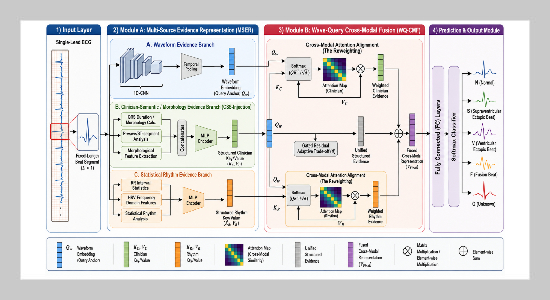
Architecture of the proposed ELBD-CDM framework.
Copyright The Author(s). This is an open access article distributed under the terms of the Creative Commons Attribution License (CC BY 4.0), which permits unrestricted use, distribution, and reproduction in any medium, provided the original author and source are cited.
Download Citation: BibTeX | http://dx.doi.org/10.6180/jase.202612_35.032
Beat-level ECG classification is difficult because morphologically similar beats can cross AAMI boundaries, minority classes are sparse, and complementary cues are often fused implicitly. ELBD-CDM preserves waveform, clinician-semantic and morphological, and statistical rhythm evidence as separate streams. MSER constructs beat-level evidence, and WQ-CMF uses the waveform query embedding to assign sample-specific weights rather than fixed concatenation. Under the adopted MIT-BIH beat-level stratified protocol, ELBD-CDM achieved 99.24% Accuracy, 95.51% Macro-F1, and 99.25% Weighted-F1. F1 scores for S, F, and Q were 94.00%, 90.00%, and 95.00%, respectively. Removing MSER and WQ-CMF reduced Macro-F1 by 4.96 and 4.05 percentage points. Under the strongest waveform-branch Gaussian-noise setting (40 dB), ELBD-CDM retained 83.6% Macro-F1 and outperformed the reproduced comparators. The test set contained 460 S, 141 F, and 1,193 Q beats; therefore, Macro-F1 was emphasized over Accuracy. These results support sample-specific evidence fusion under this protocol, although inter-patient and external validation remain necessary.
Keywords: ECG; arrhythmia; beat-level classification; multi-source evidence fusion; cross-modal fusion.
- [1] P. De Chazal, M. O’Dwyer, and R. B. Reilly, (2004) “Automatic classification of heartbeats using ECG morphology and heartbeat interval features” IEEE transactions on biomedical engineering 51(7): 1196-1206. DOI: https://doi.org/10.1109/TBME.2004.827359.
- [2] S. Kiranyaz, T. Ince, and M. Gabbouj, (2015) “Real-time patient-specific ECG classification by 1-D convolutional neural networks” IEEE transactions on biomedical engineering 63(3): 664-675. DOI: https://doi.org/10.1109/TBME.2015.2468589.
- [3] U. R. Acharya, S. L. Oh, Y. Hagiwara, J. H. Tan, M. Adam, A. Gertych, and R. San Tan, (2017) “A deep convolutional neural network model to classify heartbeats” Computers in biology and medicine 89: 389-396. DOI: https://doi.org/10.1016/j.compbiomed.2017.08.022.
- [4] M. Kachuee, S. Fazeli, and M. Sarrafzadeh, (2018) “Ecg heartbeat classification: A deep transferable representation” arXiv preprint arXiv:1805.00794: DOI: https://doi.org/10.1109/ICHI.2018.00092.
- [5] S. L. Oh, E. Y. Ng, R. San Tan, and U. R. Acharya, (2018) “Automated diagnosis of arrhythmia using combination of CNN and LSTM techniques with variable length heart beats” Computers in biology and medicine 102: 278-287. DOI: https://doi.org/10.1016/j.compbiomed.2018.06.002.
- [6] S. Mousavi and F. Afghah. “Inter-and intra-patient ecg heartbeat classification for arrhythmia detection: a sequence to sequence deep learning approach”. In: ICASSP 2019-2019 IEEE international conference on acoustics, speech and signal processing (ICASSP). IEEE. 2019, 1308-1312. DOI: https://doi.org/10.1109/ICASSP.2019.8683140.
- [7] F. Khan, X. Yu, Z. Yuan, and A. U. Rehman, (2023) “ECG classification using 1-D convolutional deep residual neural network” Plos one 18(4): e0284791. DOI: https://doi.org/10.1371/journal.pone.0284791.
- [8] Y. Zhao, J. Ren, B. Zhang, J. Wu, and Y. Lyu, (2023) “An explainable attention-based TCN heartbeats classification model for arrhythmia detection” Biomedical Signal Processing and Control 80: 104337. DOI: https://doi.org/10.1016/j.bspc.2022.104337.
- [9] R. S. Alkhawaldeh, B. Al-Ahmad, A. Ksibi, N. Ghatasheh, E. M. Abu-Taieh, G. Aldehim, M. Ayadi, and S. M. Alkhawaldeh, (2023) “Convolution neural network bidirectional long short-term memory for heartbeat arrhythmia classification” International Journal of Computational Intelligence Systems 16(1): 197. DOI: https://doi.org/10.1007/s44196-023-00374-8.
- [10] B.-T. Pham, P. T. Le, T.-C. Tai, Y.-C. Hsu, Y.-H. Li, and J.-C. Wang, (2023) “Electrocardiogram heartbeat classification for arrhythmias and myocardial infarction” Sensors 23(6): 2993. DOI: https://doi.org/10.3390/s23062993.
- [11] X. Bai, X. Dong, Y. Li, R. Liu, and H. Zhang, (2024) “A hybrid deep learning network for automatic diagnosis of cardiac arrhythmia based on 12-lead ECG” Scientific Reports 14(1): 24441. DOI: https://doi.org/10.1038/s41598-024-75531-w.
- [12] B. Zheng, W. Luo, M. Zhang, and H. Jin, (2025) “Arrhythmia classification based on multi-input convolutional neural network with attention mechanism” Plos one 20(6): e0326079. DOI: https://doi.org/10.1371/journal.pone.0326079.
- [13] M. Karri and C. S. R. Annavarapu, (2023) “A real-time embedded system to detect QRS-complex and arrhythmia classification using LSTM through hybridized features” Expert Systems with Applications 214: 119221. DOI: https://doi.org/10.1016/j.eswa.2022.119221.
- [14] K. Balakrishnan, D. Velusamy, K. Ramasamy, and L. Pruinelli, (2025) “ECG-based cardiac arrhythmia classification using fuzzy encoded features and deep neural networks” Biomedical Engineering Advances 9: 100167. DOI: https://doi.org/10.1016/j.bea.2025.100167.
- [15] H. Ismail Fawaz, B. Lucas, G. Forestier, C. Pelletier, D. F. Schmidt, J. Weber, G. L. Webb, L. Idoumghar, P.-A. Muller, and F. Petitjean, (2020) “Inceptiontime: Finding alexnet for time series classification” Data mining and knowledge discovery 34(6): 1936-1962. DOI: https://doi.org/10.1007/s10618-020-00710-y.
- [16] G. B. Moody and R. G. Mark, (2001) “The impact of the MIT-BIH arrhythmia database” IEEE engineering in medicine and biology magazine 20(3): 45-50. DOI: https://doi.org/10.1109/51.932724.
- [17] G. Moody and R. Mark. MIT-BIH Arrhythmia Database (version 1.0.0). PhysioNet. 2005. DOI: https://doi.org/10.13026/C2F305.
- [18] M. A. Raza, M. Anwar, K. Nisar, A. A. A. Ibrahim, U. A. Raza, S. A. Khan, and F. Ahmad, (2023) “Classification of electrocardiogram signals for arrhythmia detection using convolutional neural network” Computers, Materials and Continua 77(3): 3817-3834. DOI: https://doi.org/10.32604/cmc.2023.032275.
- [19] E. J. d. S. Luz, W. R. Schwartz, G. Cámara-Chávez, and D. Menotti, (2016) “ECG-based heartbeat classification for arrhythmia detection: A survey” Computer methods and programs in biomedicine 127: 144-164. DOI: https://doi.org/10.1016/j.cmpb.2015.12.008.
- [20] P. Wagner, N. Strodthoff, R.-D. Bousseljot, D. Kreiseler, F. L. Lunze, W. Samek, and T. Schaeffter, (2020) “PTB-XL, a large publicly available electrocardiography dataset” Scientific data 7(1): 154. DOI: https://doi.org/10.6084/m9.figshare.12098055.
- [21] N. Strodthoff, P. Wagner, T. Schaeffter, and W. Samek, (2020) “Deep learning for ECG analysis: Benchmarks and insights from PTB-XL” IEEE journal of biomedical and health informatics 25(5): 1519-1528. DOI: https://doi.org/10.1109/JBHI.2020.3022989.