




Chengdu College of University of Electronic Science and Technology of China, Chengdu 611731, China
Received: May 27, 2026
Accepted: August 17, 2026
Publication Date: September 11, 2026
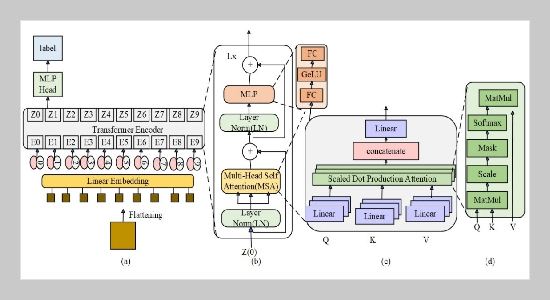
ViT Architecture
Copyright The Author(s). This is an open access article distributed under the terms of the Creative Commons Attribution License (CC BY 4.0), which permits unrestricted use, distribution, and reproduction in any medium, provided the original author and source are cited.
Download Citation: BibTeX | http://dx.doi.org/10.6180/jase.202612_35.029
Artificial Intelligence (AI) is transforming product design by automating workflows, improving decision-making, and enhancing visual quality. Traditional manual design methods are often time-consuming and lack the flexibility required for rapid, high-quality product development. This study proposes an AI-based product design framework that integrates Vision Transformers (ViT) for image enhancement and Generative Adversarial Networks (GANs) for design generation. The framework combines automated visual optimization with creative design synthesis to support innovative and efficient product development. High-quality image datasets collected from Google Images and open-source repositories were used to train and evaluate the model. ViT was applied to tasks such as super-resolution and denoising, while GANs generated realistic and diverse product designs. Model performance was evaluated using Peak Signal-to-Noise Ratio (PSNR), Structural Similarity Index (SSIM), Root Mean Squared Error (RMSE), Inception Score (IS), and Frechet Inception Distance (FID). Experimental results demonstrated notable improvements in image quality, with PSNR values ranging from 14-17 dB, SSIM from 0.72-0.87, and RMSE reduced from 54 to 40. GAN-generated outputs also achieved improved realism and diversity through higher IS and lower FID values. The proposed framework provides a scalable, efficient, and innovative solution for AI-driven product design and visual enhancement.
Keywords: Artificial Intelligence; Vision Transformers; Generative Adversarial Networks; Product Design; Visual Enhancement.
- [1] Y. Wang, Y. Xi, X. Liu, and Y. Gan, (2024) “Exploring the Dual Potential of Artificial Intelligence-Generated Content in the Esthetic Reproduction and Sustainable Innovative Design of Ming-Style Furniture” Sustainability 16(12): 5173. DOI: 10.3390/su16125173.
- [2] A. Grech, J. Mehnen, and A. Wodehouse, (2023) “An Extended AI-Experience: Industry 5.0 in Creative Product Innovation” Sensors 23(6): 3009. DOI: 10.3390/s23063009.
- [3] C.-K. M. Lee, L. Lui, and Y.-P. Tsang, (2021) “Formulation and Prioritization of Sustainable New Product Design in Smart Glasses Development” Sustainability 13(18): 10323. DOI: 10.3390/su131810323.
- [4] S. Emad, M. Aboulnaga, A. Wanas, and A. Abouaiana, (2025) “The Role of Artificial Intelligence in Developing the Tall Buildings of Tomorrow” Buildings 15(5): 749. DOI: 10.3390/buildings15050749.
- [5] O. P. Agboola, (2024) “The Role of Artificial Intelligence in Enhancing Design Innovation and Sustainability” Smart Design Policies Journal 1(1): 6-14. DOI: 10.38027/smart-v1n1-2.
- [6] S. Han and X. Sun, (2024) “Optimizing Product Design Using Genetic Algorithms and Artificial Intelligence Techniques” IEEE Access 12: 151460-151475. DOI: 10.1109/ACCESS.2024.3456081.
- [7] E. Filippova, S. Hedayat, T. Ziarati, and M. Manganelli, (2025) “Artificial Intelligence and Digital Twins for Bioclimatic Building Design: Innovations in Sustainability and Efficiency” Energies 18(19): 5230. DOI: 10.3390/en18195230.
- [8] X. Li, Y. Zhang, C. Liu, J. Zhao, and K. Li, (2026) “Artificial Intelligence for Sustainable Industrial Design: A Systematic Literature Review Based on a Technology-System-Institution Framework” Processes 14(5): 779. DOI: 10.3390/pr14050779.
- [9] J. Lin, Q. Li, C. Wang, and Z. Hu, (2024) “Product Development and Design Framework Based on Interactive Innovation in the Metaverse Perspective” Applied System Innovation 7(4): 58. DOI: 10.3390/asi7040058.
- [10] Index of /pix2pix/datasets. 2026. URL: https://efrosgans.eecs.berkeley.edu/pix2pix/datasets/ (visited on 05/02/2026).
- [11] Y. Feng, (2024) “Artificial Intelligence-Assisted Product Design: From Concept to Prototype” Journal of Progressive Engineering and Physical Sciences 3(4): 95-104. DOI: 10.56397/JPEPS.2024.12.13.
- [12] M. Ahmad, V. Hargaden, P. Ghadimi, and N. Papakostas, (2025) “AI-Driven Computer-Aided Design for Assembly and Disassembly: A Conceptual Framework” IFAC-PapersOnLine 59(21): 101-106. DOI: 10.1016/j.ifacol.2025.11.595.
- [13] J. Liao, P. Hansen, and C. Chai, (2020) “A framework of artificial intelligence augmented design support” Human-Computer Interaction 35(5-6): 511-544. DOI: 10.1080/07370024.2020.1733576.
- [14] L. S. Furtado, J. B. Soares, and V. Furtado, (2024) “A task-oriented framework for generative AI in design” Journal of Creativity 34(2): 100086. DOI: 10.1016/j.yjoc.2024.100086.
- [15] Y. Yu and S. Wang. “Pioneering and Mining Artificial Intelligence-Driven Design Innovation in the Context of Digitization”. In: Proceedings of the 4th International Conference on Artificial Intelligence and Computer Engineering. 2023, 1145-1152. DOI: 10.1145/3652628.3652816.