




Faculty of Digital-intelligent Urban Construction & Creative Design, Wenhua College, Wuhan, 430074, China
Received: July 21, 2026
Accepted: August 14, 2026
Publication Date: September 11, 2026
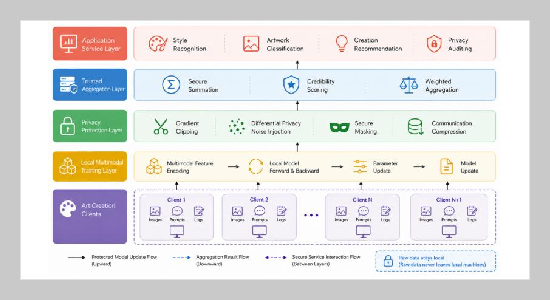
Scalable federated learning system architecture for distributed art creation data
Copyright The Author(s). This is an open access article distributed under the terms of the Creative Commons Attribution License (CC BY 4.0), which permits unrestricted use, distribution, and reproduction in any medium, provided the original author and source are cited.
Download Citation: BibTeX | http://dx.doi.org/10.6180/jase.202612_35.027
Digital art platforms, AIGC systems, and cross-institutional design collaboration platforms continuously generate multimodal artistic creation data that are privacy-sensitive and distributed across many clients. Centralized modeling risks exposure while ordinary federated learning struggles with non-IID styles and gradient leakage. This study proposes SAP-FL, combining local multimodal training with gradient clipping, DP noise, secure aggregation, credibility-weighted aggregation, and compression for cross-node modeling without raw data leaving devices. On non-IID data, SAP-FL achieves F1 of 84.01% (vs. 81.74%/79.11% for FedAvg/DP-FedAvg), reduces membership inference success to 49.70% (20.10 points below FedAvg), and retains F1 of 82.36% at 200 clients. Grad-CAM shows SAP-FL consistently attends to brushstroke-dense regions and subject outlines.
Keywords: differential privacy; secure aggregation; non-IID data; multimodal fusion; Grad-CAM interpretability.
- [1] S. Feuerriegel, J. Hartmann, C. Janiesch, and P. Zschech, (2024) “Generative Al” Business & Information Systems Engineering 66(1): 111-126. DOI: https://doi.org/10.1007/s12599-023-00834-7.
- [2] E. Zhou and D. Lee, (2024) “Generative Artificial Intelligence, Human Creativity, and Art” PNAS Nexus 3(3): DOI: https://doi.org/10.1093/pnasnexus/pgae052.
- [3] Z. Epstein, A. Hertzmann, Investigators of Human Creativity, M. Akten, H. Farid, J. Fjeld, M. R. Frank, M. Groh, L. Herman, N. Leach, R. Mahari, A. Pentland, O. Russakovsky, H. Schroeder, and A. Smith, (2023) “Art and the Science of Generative Al” Science 380(6650): 1110-1111. DOI: https://doi.org/10.1126/science.adh4451.
- [4] P. Kairouz, H. B. McMahan, B. Avent, A. Bellet, M. Bennis, A. N. Bhagoji, K. Bonawitz, Z. Charles, G. Cormode, R. Cummings, R. G. L. D’Oliveira, H. Eichner, S. El Rouayheb, D. Evans, J. Gardner, Z. Garrett, A. Gascón, B. Ghazi, P. B. Gibbons, S. Zhao, et al., (2021) “Advances and Open Problems in Federated Learning” Foundations and Trends in Machine Learning 14(1-2): 1-210. DOI: https://doi.org/10.1561/2200000083.
- [5] C. Zhang, Y. Xie, H. Bai, B. Yu, W. Li, and Y. Gao, (2021) “A Survey on Federated Learning” Knowledge-Based Systems 216: DOI: https://doi.org/10.1016/j.knosys.2021.106775.
- [6] H. Zhu, J. Xu, S. Liu, and Y. Jin, (2021) “Federated Learning on Non-IID Data: A Survey” Neurocomputing 465: 371-390. DOI: https://doi.org/10.1016/j.neucom.2021.07.098.
- [7] N. Bouacida and P. Mohapatra, (2021) “Vulnerabilities in Federated Learning” IEEE Access 9: 63229-63249. DOI: https://doi.org/10.1109/ACCESS.2021.3075203.
- [8] X. Yin, Y. Zhu, and J. Hu, (2021) “A Comprehensive Survey of Privacy-Preserving Federated Learning: A Taxonomy, Review, and Future Directions” ACM Computing Surveys 54(6): 1-36. DOI: https://doi.org/10.1145/3460427.
- [9] A. El Ouadrhiri and A. Abdelhadi, (2022) “Differential Privacy for Deep and Federated Learning: A Survey” IEEE Access 10: 22359-22380. DOI: https://doi.org/10.1109/ACCESS.2022.3151670.
- [10] A. Blanco-Justicia, J. Domingo-Ferrer, S. Martínez, D. Sánchez, A. Flanagan, and K. E. Tan, (2021) “Achieving Security and Privacy in Federated Learning Systems: Survey, Research Challenges and Future Directions” Engineering Applications of Artificial Intelligence 106: DOI: https://doi.org/10.1016/j.engappai.2021.104468.
- [11] J. Chen, H. Yan, Z. Liu, M. Zhang, H. Xiong, and S. Yu, (2024) “When Federated Learning Meets Privacy-Preserving Computation” ACM Computing Surveys 56(12): 1-36. DOI: https://doi.org/10.1145/3679013.
- [12] M. Chen, N. Shlezinger, H. V. Poor, Y. C. Eldar, and S. Cui, (2021) “Communication-Efficient Federated Learning” Proceedings of the National Academy of Sciences 118(17): DOI: https://doi.org/10.1073/pnas.2024789118.
- [13] L. Che, J. Wang, Y. Zhou, and F. Ma, (2023) “Multimodal Federated Learning: A Survey” Sensors 23(15): DOI: https://doi.org/10.3390/s23156986.
- [14] A. Hatamizadeh, H. Yin, P. Molchanov, A. Myronenko, W. Li, P. Dogra, A. Feng, M. G. Flores, J. Kautz, D. Xu, and H. R. Roth, (2023) “Do Gradient Inversion Attacks Make Federated Learning Unsafe?” IEEE Transactions on Medical Imaging 42(7): 2044-2056. DOI: https://doi.org/10.1109/TMI.2023.3239391.
- [15] K. Szczepankiewicz, A. Popowicz, K. Charkiewicz, K. Nałęcz-Charkiewicz, M. Szczepankiewicz, S. Lasota, P. Zawistowski, and K. Radlak, (2023) “Ground Truth Based Comparison of Saliency Maps Algorithms” Scientific Reports 13: DOI: https://doi.org/10.1038/s41598-023-42946-w.