




Duong Duc Tai1,2, Vu Van Quang1
1Precision Engineering & Smart Measurement Lab, School of Mechanical Engineering, Hanoi University of Science and Technology, No. 1 Dai Co Viet Street, Hanoi 100000, Vietnam.
2Sumitomo Electronic Components (Vietnam) Co., Ltd
Received: June 20, 2026
Accepted: August 03, 2026
Publication Date: September 06, 2026
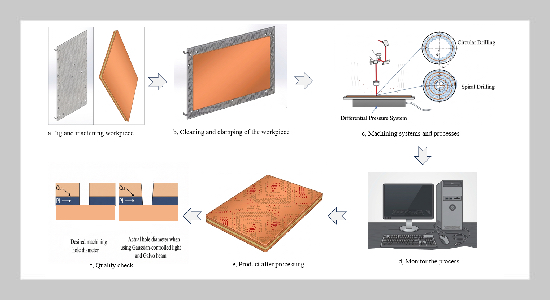
Schematic of the experimental machining process.
Copyright The Author(s). This is an open access article distributed under the terms of the Creative Commons Attribution License (CC BY 4.0), which permits unrestricted use, distribution, and reproduction in any medium, provided the original author and source are cited.
Download Citation: BibTeX | http://dx.doi.org/10.6180/jase.202612_35.022
Conductive microvias in flexible printed circuits (FPCs) play a critical role in establishing electrical interconnections between circuit layers and directly affect the reliability of electronic systems. However, microvia drilling in flexible copper-clad laminate (FCCL) substrates with heterogeneous Cu-PI structures remain challenging because copper and polyimide exhibit significantly different optical, thermal, and ablation characteristics. This study proposes an integrated nanosecond UV laser machining strategy in which laser power, pulse repetition rate, scanning speed, and pressure-assisted debris extraction are coordinated to control the accumulated energy distribution and improve microvia quality. The hole-formation and material-removal mechanisms are analyzed based on laser-material interaction theory and an accumulated-energy model to guide parameter selection. Experiments were conducted using an industrial 355 nm UV Nd:YAG laser system with spiral and circular drilling strategies[cite: 15]. The results show that the optimized processing conditions, combining lower laser power, lower pulse repetition rate, higher scanning speed, and pressure-assisted debris removal, improved the taper ratio by 18.94 percentage points for spiral drilling and 6.42 percentage points for circular drilling compared with the baseline conditions. EDX analysis indicated a reduction in carbon-containing residues on the microvia sidewalls, with the carbon content decreasing from 11.87% to 9.29% for spiral drilling and from 8.86% to 7.54% for circular drilling. Meanwhile, SEM observations and laser microscopy confirmed improvements in hole geometry, surface quality, and taper control. These findings demonstrate the potential of the proposed strategy for stable and industrially compatible microvia fabrication in flexible electronic circuits.
Keywords: Conductive microvias; Flexible printed circuits/FPCs; Nanosecond UV laser machining; microvia quality; Cu-PI structures.
- [1] L. Zheng, S. Lin, H. Lu, B. Huang, Y. Liu, J. Wang, X. Wei, J. Wang, and C. Wang, (2024) “Characterization of Micro-Holes Drilled Using a UV Femtosecond Laser in Modified Polyimide Flexible Circuit Boards” Micromachines 15(9): 1078. DOI: https://doi.org/10.3390/mi15091078.
- [2] H. Lu, Z. Ou, B. Huang, X. Huang, C. Wang, and L. Zheng, (2022) “Study on Micro-holes Processing of High Frequency Flexible Copper Clad Laminate Substrate via Femtosecond Laser” Mechanical Science and Technology for Aerospace Engineering 41(8): 1224-1230. DOI: https://doi.org/10.13433/j.cnki.1003-8728.20220151.
- [3] K.-R. Kim, J.-H. Cho, N.-Y. Lee, H.-J. Kim, S.-H. Cho, H.-J. Park, and B. Choi, (2016) “High-precision and ultrafast UV laser system for next-generation flexible PCB drilling” Journal of Manufacturing Systems 38: 107-113. DOI: https://doi.org/10.1016/j.jmsy.2015.12.001.
- [4] H. Zheng, E. Gan, and G. C. Lim, (2001) “Investigation of laser via formation technology for the manufacturing of high density substrates” Optics and Lasers in Engineering 36(4): 355-371. DOI: https://doi.org/10.1016/S0143-8166(01)00057-4.
- [5] Z. Huang, Y. Cai, Z. Zhang, N. Li, F. Shi, W. Lin, and H. Liu, (2025) “Laser drilling of micro-holes with controllable taper using 355 nm nanosecond laser” Optics & Laser Technology 181: 111929. DOI: https://doi.org/10.1016/j.optlastec.2024.111929.
- [6] K. C. Yung, D. W. Zeng, and T. M. Yue, (2002) “High repetition rate effect on the chemical characteristics and composition of Upilex-S polyimide ablated by a UV Nd:YAG laser” Surface and Coatings Technology 160(1): 1-6. DOI: https://doi.org/10.1016/S0257-8972(02)00384-5.
- [7] P. Deepu, T. Jagadesh, and M. Duraiselvam, (2023) “Investigations into morphology and surface integrity of micro-hole during femtosecond laser drilling of titanium alloy” Journal of the Brazilian Society of Mechanical Sciences and Engineering 45(10): 516. DOI: https://doi.org/10.1007/s40430-023-04449-7.
- [8] Y. Dong, Q. Ye, Q. Li, X. Guo, S. Zhang, and N. Hou, (2022) “Numerical Simulation and Validation of Multi-scale 3D Laser Spiral Machining of Microholes” Laser and Particle Beams 2022: e22. DOI: https://doi.org/10.1155/2022/2455226.
- [9] M. Li, Y. Chen, L. Dong, D. Liu, and X. Sun, (2025) “Quality Evaluation of Micro-Holes Processed by Efficient One-Step Femtosecond Laser Helical Drilling Method in Nickel-Based Superalloy” Applied Sciences 15(8): 4384. DOI: https://doi.org/10.3390/app15084384.
- [10] Z. Gu, Y. He, J. Yang, Y. Fu, J. Ji, Y. Zhang, J. Li, and G. Liu, (2023) “Dual-path micro-holes process for 0Cr17Ni7Al stainless steel thin plate with picosecond laser” Journal of Manufacturing Processes 101: 1224-1233. DOI: https://doi.org/10.1016/j.jmapro.2023.07.004.
- [11] Z. Qin, J. Yang, J. Niu, L. Chen, K. Cao, T. Jia, and H. Xu, (2025) “Precision control of hole morphology by modulating femtosecond laser beam track with a four-wedge drilling system” Optics & Laser Technology 192: 113972. DOI: https://doi.org/10.1016/j.optlastec.2025.113972.
- [12] X. Sun, X. Dong, K. Wang, P. Fan, T. Sun, X. Mei, and Z. Fan, (2024) “Femtosecond laser processing of controlled tapered micro-holes based on dynamic control of relative attitude” Optics & Laser Technology 170: 110201. DOI: https://doi.org/10.1016/j.optlastec.2023.110201.
- [13] S. Gonumakulapalle Lodi and S. Kumar, (2024) “Experimental Investigation on the Annular Drilling of Acute Angle Micro-Holes in Nickel Based Superalloy With Femtosecond Laser” Proceedings of the ASME 2024 International Mechanical Engineering Congress and Exposition (IMECE2024) 2: V002T03A068. DOI: https://doi.org/10.1115/IMECE2024-145332.
- [14] X. Liu, Y. Wang, Y. Yang, L. Bao, Y. Liu, W. Zhang, and L. Li, (2025) “Fabrication of micro holes with high surface quality and integrity by high-speed laser trepanning and electrochemical post-treatment” The International Journal of Advanced Manufacturing Technology 137: 67-81. DOI: https://doi.org/10.1007/s00170-025-15229-2.
- [15] N. Zhang, M. Wang, M. Ban, L. Guo, and W. Liu, (2024) “Femtosecond laser drilling 100 µm diameter micro holes with aspect ratios >20 in a nickel-based superalloy” Journal of Materials Research and Technology 28: 1415-1422. DOI: https://doi.org/10.1016/j.jmrt.2023.12.049.
- [16] P. Deepu and T. Jagadesh, (2024) “Femtosecond Laser Micro Drilling of Cooling Holes on Thermal Barrier Coated Titanium Alloy for Aeroengine Application” Journal of Materials Engineering and Performance 33(19): 10242-10263. DOI: https://doi.org/10.1007/s11665-023-08679-7.
- [17] Z. Zhao, Y. Yu, R. Sun, W. Zhao, H. Guo, Z. Zhang, and C. Wang, (2023) “Design of a Femtosecond Laser Percussion Drilling Process for Ni-Based Superalloys Based on Machine Learning and the Genetic Algorithm” Micromachines 14(11): 2110. DOI: https://doi.org/10.3390/mi14112110.