


Xiaozan Zhu1, Haiting Zhang1, and Min Cai2
1School of Marxism, Weifang Engineering Vacational College, Weifang 262500, Shandong, China
2School of Continuing Education, Weifang Engineering Vacational College, Weifang 262500, Shandong, China
Received: June 03, 2026
Accepted: July 29, 2026
Publication Date: September 06, 2026
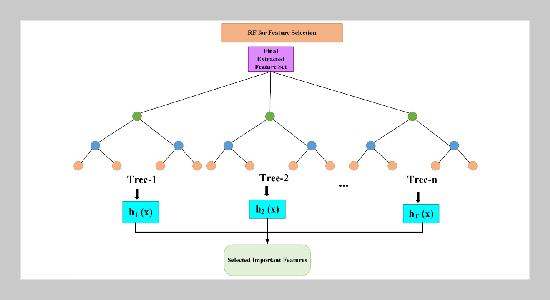
RF architecture for feature selection
Copyright The Author(s). This is an open access article distributed under the terms of the Creative Commons Attribution License (CC BY 4.0), which permits unrestricted use, distribution, and reproduction in any medium, provided the original author and source are cited.
Download Citation: BibTeX | http://dx.doi.org/10.6180/jase.202612_35.016
The rapid growth of educational data has enabled big data analytics to improve engagement analysis and student success prediction. However, existing approaches primarily focus on prediction accuracy while overlooking engagement patterns and recommendation mechanisms. This research proposes an integrated big data framework to analyse engagement patterns, predict national-level student success and support policy-level labour-course planning. The framework uses OECD Education Global Positioning System (GPS) data and includes data preprocessing, feature extraction, K-means clustering, and an Adaptive Grey Wolf Optimizer (GWO)-based Hybrid Random Forest-Deep Neural Network (RF-DNN) model for feature selection, prediction, and hyperparameter optimization. A rules-based recommender system generates mathematics-focused labour-course recommendations based on predicted success and engagement patterns. Experimental results achieved R² = 0.982, MSE = 0.0005, RMSE = 0.0225, and MAE = 0.0135, demonstrating high prediction accuracy and low error. The proposed framework provides a scalable solution for engagement analysis, student success prediction, and policy-level course recommendations.
Keywords: Big Data Analytics, Student Engagement, Random Forest, Deep Neural Network, Adaptive Grey Wolf Optimizer, Course Recommendation
- [1] C. J. Arizmendi et al., (2023) “Predicting Student Outcomes Using Digital Logs of Learning Behaviors: Review, Current Standards, and Suggestions for Future Work” Behavior Research Methods 55(6): 3026-3054. DOI: https://doi.org/10.3758/s13428-022-01939-9.
- [2] R. Isaeva, I. Ratinen, and S. Uusiautti, (2023) “Understanding Student Success in Higher Education in Azerbaijan: The Role of Student Engagement” Studies in Higher Education 48(12): 1918-1936. DOI: https://doi.org/10.1080/03075079.2023.2217208.
- [3] M. Nachouki, E. A. Mohamed, R. Mehdi, and M. Abou Naaj, (2023) “Student Course Grade Prediction Using the Random Forest Algorithm: Analysis of Predictors’ Importance” Trends in Neuroscience and Education 33: 100214. DOI: https://doi.org/10.1016/j.tine.2023.100214.
- [4] P. Asthana, S. Mishra, N. Gupta, M. Derawi, and A. Kumar, (2023) “Prediction of Student’s Performance With Learning Coefficients Using Regression Based Machine Learning Models” IEEE Access 11: 72732-72742. DOI: https://doi.org/10.1109/ACCESS.2023.3294700.
- [5] N. I. Mohd Talib, N. A. Abd Majid, and S. Sahran, (2023) “Identification of Student Behavioral Patterns in Higher Education Using K-Means Clustering and Support Vector Machine” Applied Sciences 13(5): 3267. DOI: https://doi.org/10.3390/app13053267.
- [6] Y. Baashar et al., (2022) “Toward Predicting Student’s Academic Performance Using Artificial Neural Networks (ANNs)” Applied Sciences 12(3): 1289. DOI: https://doi.org/10.3390/app12031289.
- [7] K. Fahd and S. J. Miah, (2023) “Designing and Evaluating a Big Data Analytics Approach for Predicting Students’ Success Factors” Journal of Big Data 10(1): 159. DOI: https://doi.org/10.1186/s40537-023-00835-z.
- [8] M. Shoaib, N. Sayed, J. Singh, J. Shafi, S. Khan, and F. Ali, (2024) “AI Student Success Predictor: Enhancing Personalized Learning in Campus Management Systems” Computers in Human Behavior 158: 108301. DOI: https://doi.org/10.1016/j.chb.2024.108301.
- [9] F. Ouatik, M. Erritali, F. Ouatik, and M. Jourhmane, (2022) “Predicting Student Success Using Big Data and Machine Learning Algorithms” International Journal of Emerging Technologies in Learning 17(12): 236-251.
- [10] Namraiza, K. Abid, N. Aslam, M. Fuzail, M. S. Maqbool, and K. Sajid, (2023) “An Efficient Deep Learning Approach for Prediction of Student Performance Using Neural Network” VFAST Transactions on Software Engineering 11(4): 67-79. DOI: https://doi.org/10.21015/vtse.v11i4.1647.
- [11] A. Mohanarathinam, M. Arunkumar, and K. Subramaniam, (2026) “An Attentive Deep Learning Framework for the Prediction of Academic Performance of Students in Virtual Learning Environments” International Journal of Software Engineering and Knowledge Engineering 36(13): 1821-1844. DOI: https://doi.org/10.1142/S0218194026500026.
- [12] Y. S. Balcioğlu and M. Artar, (2025) “Predicting Academic Performance of Students with Machine Learning” Information Development 41(3): 896-915. DOI: https://doi.org/10.1177/02666669231213023.
- [13] Organisation for Economic Co-operation and Development. OECD Education GPS. Accessed: 2026-07-18. 2026.
- [14] A. Abdelhadi, S. Zainudin, and N. S. Sani, (2022) “A Regression Model to Predict Key Performance Indicators in Higher Education Enrollments” International Journal of Advanced Computer Science and Applications 13(1): DOI: https://doi.org/10.14569/IJACSA.2022.0130156.
- [15] E. Alhazmi and A. Sheneamer, (2023) “Early Predicting of Students Performance in Higher Education” IEEE Access 11: 27579-27589. DOI: https://doi.org/10.1109/ACCESS.2023.3250702.