



Vo Tran Minh Khoa1, Nguyen Manh Khang1, Huynh Diem Nhung1, Van Chi Khen1, Pham Thi Tuyet1,2, and Nguyen Quang Long1,2
1Faculty of Chemical Engineering, Ho Chi Minh City University of Technology (HCMUT), 268 Ly Thuong Kiet Street, Dien Hong
2ward, Ho Chi Minh City, Vietnam; Vietnam National University Ho Chi Minh City (VNU-HCM), Ho Chi Minh City, Vietnam
Received: March 30, 2026
Accepted: July 13, 2026
Publication Date: August 26, 2026
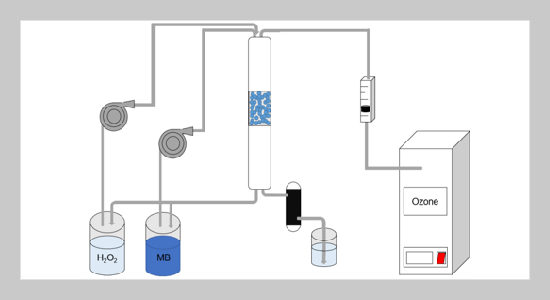
Column-based system design for methylene blue treatment.
Copyright The Author(s). This is an open access article distributed under the terms of the Creative Commons Attribution License (CC BY 4.0), which permits unrestricted use, distribution, and reproduction in any medium, provided the original author and source are cited.
Download Citation: BibTeX | http://dx.doi.org/10.6180/jase.202612_35.004
The design of regenerable adsorbents is critical for sustainable wastewater treatment. Mesoporous zeolite Y pellets were synthesized through hydrothermal dealumination-desilication and modified by Fe³⁺ and Mn²⁺ ion exchange. Characterization confirmed preservation of the FAU framework, while BET analysis showed enlarged external surface areas of 102 m²/g for hierarchical Y, 81 m²/g for VM80, and 72 m²/g for Fe-VM80. Column experiments indicated that methylene blue adsorption followed pseudo-first-order kinetics[cite: 5]. Ozone regeneration outperformed the Fenton process, shortening treatment times to 1.5 h for Mn-VM80 and 1 h for Fe-VM80 while maintaining higher cyclic stability. The combination of hierarchical porosity, pelletization, and Fe/Mn modification enabled efficient adsorption-desorption cycling. These ozone-regenerable mesoporous zeolite Y pellets show strong potential as scalable and sustainable adsorbents for dye removal.
Keywords: Mesoporous zeolite Y; MB adsorption; Regeneration; Ozonation; hydrothermal synthesis
- [1] D. Zhao, W. Zhang, C. Chen, and X. Wang, (2013) “Adsorption of Methyl Orange Dye Onto Multiwalled Carbon Nanotubes” Procedia Environmental Sciences 18: 890-895. DOI: 10.1016/j.proenv.2013.04.120.
- [2] L. Wu, X. Liu, G. Lv, R. Zhu, L. Tian, M. Liu, Y. Li, W. Rao, T. Liu, and L. Liao, (2021) “Study on the adsorption properties of methyl orange by natural one-dimensional nano-mineral materials with different structures” Scientific Reports 11: 10640. DOI: 10.1038/s41598-021-90235-1.
- [3] S. Rahmani, B. Zeynizadeh, and S. Karami, (2020) “Removal of cationic methylene blue dye using magnetic and anionic-cationic modified montmorillonite: kinetic, isotherm and thermodynamic studies” Applied Clay Science 184: 105391. DOI: 10.1016/j.clay.2019.105391.
- [4] J. Fito, M. Abewaa, A. Mengistu, K. Angassa, A. D. Ambaye, W. Moyo, and T. Nkambule, (2023) “Adsorption of methylene blue from textile industrial wastewater using activated carbon developed from Rumex abyssinicus plant” Scientific Reports 13: 5427. DOI: 10.1038/s41598-023-32341-w.
- [5] N. M. Thuan, N. T. M. Linh, N. T. T. Phuong, N. T. H. Duong, N. M. Hung, P. T. Tuyet, N. Van Dung, and N. Q. Long, (2024) “Ethanolamine-modified zeolite-Chitosan beads as new adsorbents for carbon dioxide capture and crystal violet removal” Case Studies in Chemical and Environmental Engineering 10: 100917. DOI: 10.1016/j.cscee.2024.100917.
- [6] F. Poorsajadi, M. H. Sayadi, M. Hajiani, and M. R. Rezaei, (2022) “Synthesis of CuO/Bi2O3 nanocomposite for efficient and recycling photodegradation of methylene blue dye” International Journal of Environmental Analytical Chemistry 102: 7165-7178. DOI: 10.1080/03067319.2020.1826464.
- [7] C. Kathing and G. Saini, (2022) “A Review of Various Treatment Methods for the Removal of Dyes from Textile Effluent” Recent Progress in Materials 4: 1-15. DOI: 10.21926/rpm.2204028.
- [8] C. Langa, N. Mabuba, L. M. Mahlaule-Glory, D. E. Motaung, Z. Tetana, and N. C. Hintsho-Mbita, (2026) “Enhanced photocatalytic degradation of dyes and pharmaceutical pollutants using Fe/TiO2-carbon nanospheres from Sutherlandia Frutescence” International Journal of Environmental Analytical Chemistry 106: 790-820. DOI: 10.1080/03067319.2025.2524833.
- [9] L. Mouni, L. Belkhiri, J.-C. Bollinger, A. Bouzaza, A. Assadi, A. Tirri, F. Dahmoune, K. Madani, and H. Remini, (2018) “Removal of Methylene Blue from aqueous solutions by adsorption on Kaolin: Kinetic and equilibrium studies” Applied Clay Science 153: 38-45. DOI: 10.1016/j.clay.2017.11.034.
- [10] G. Bal and A. Thakur, (2022) “Distinct approaches of removal of dyes from wastewater: A review” Materials Today: Proceedings 50: 1575-1579. DOI: 10.1016/j.matpr.2021.09.119.
- [11] K. Rida, S. Bouraoui, and S. Hadnine, (2013) “Adsorption of methylene blue from aqueous solution by kaolin and zeolite” Applied Clay Science 83-84: 99-105. DOI: 10.1016/j.clay.2013.08.015.
- [12] T. P. Le, H. V. T. Luong, H. N. Nguyen, T. K. T. Pham, T. L. Trinh Le, T. B. Q. Tran, and T. N. M. Ngo, (2024) “Insight into adsorption-desorption of methylene blue in water using zeolite NaY: Kinetic, isotherm and thermodynamic approaches” Results in Surfaces and Interfaces 16: 100281. DOI: 10.1016/j.rsurfi.2024.100281.
- [13] N. M. Khang, V. T. Minh Khoa, N. T. Truc Phuong, N. X. Du, N. T. Hoang Duong, N. Van Dung, T. T. Tuyet Mai, and N. Q. Long, (2025) “Double-xerogel network composite zeolite granules targeting dual-functional fertilizers” Case Studies in Chemical and Environmental Engineering 12: 101253. DOI: 10.1016/j.cscee.2025.101253.
- [14] D. M. El-Mekkawi, F. A. Ibrahim, and M. M. Selim, (2016) “Removal of methylene blue from water using zeolites prepared from Egyptian kaolins collected from different sources” Journal of Environmental Chemical Engineering 4: 1417-1422. DOI: 10.1016/j.jece.2016.01.007.
- [15] H. J. Choi, D. Jo, J. G. Min, and S. B. Hong, (2021) “The Origin of Selective Adsorption of CO2 on Merlinoite Zeolites” Angewandte Chemie International Edition 60: 4307-4314. DOI: 10.1002/anie.202012953.
- [16] B. Reiprich, T. Weissenberger, W. Schwieger, and A. Inayat, (2020) “Layer-like FAU-type zeolites: A comparative view on different preparation routes” Frontiers of Chemical Science and Engineering 14: 127-142. DOI: 10.1007/s11705-019-1883-3.
- [17] M. Narimani, M. Gonbadi, and M. M. Zerafat, (2025) “Methylene blue adsorption on Y-zeolite as a nano-porous adsorbent: equilibrium and kinetic studies” International Journal of Environmental Analytical Chemistry 105: 5369-5389. DOI: 10.1080/03067319.2024.2392632.
- [18] N. T. T. Phuong, N. M. Thuan, N. T. M. Linh, N. Van Dung, N. T. H. Duong, and N. Q. Long, (2024) “Effects of organic acids on microwave-assisted leaching for mesopore generation in FAU zeolite” Applied Physics A 130: 734. DOI: 10.1007/s00339-024-07879-9.
- [19] X. Yin, Z. Li, S. Wang, N. Chu, J. Yang, and J. Wang, (2015) “Hydrothermal synthesis of hierarchical zeolite T aggregates using tetramethylammonium hydroxide as single template” Microporous and Mesoporous Materials 201: 247-257. DOI: 10.1016/j.micromeso.2014.09.018.
- [20] T. T. P. Nguyen, Q. T. Le Nguyen, H. H. Lam, V. D. Nguyen, H. D. Ngo Tran, and N. Quang Long, (2022) “Enhancement Of CO2 Adsorption By Introducing Mesopores Into FAU Zeolite Using Acid-Base Leaching” Journal of Applied Science and Engineering 26: 791-798. DOI: 10.6180/jase.202306_26(6).0005.
- [21] R. Zhang, P. Zhong, H. Arandiyan, Y. Guan, J. Liu, N. Wang, Y. Jiao, and X. Fan, (2020) “Using ultrasound to improve the sequential post-synthesis modification method for making mesoporous Y zeolites” Frontiers of Chemical Science and Engineering 14: 275-287. DOI: 10.1007/s11705-019-1905-1.
- [22] Z. Asgar Pour, M. Abduljawad, Y. Alassmy, L. Cardon, P. Steenberge, and K. Sebakhy, (2023) “A Comparative Review of Binder-Containing Extrusion and Alternative Shaping Techniques for Structuring of Zeolites into Different Geometrical Bodies” Catalysts 13: 656. DOI: 10.3390/catal13040656.
- [23] Q. G. Ho, L. T. Bui, P. T. T. Nguyen, D. T. H. Ngo, and L. Q. Nguyen, (2023) “Modification of ZSM-5 Catalyst Using Microwave-Assisted and Thermal Methods: Characterizations and n-Heptane Cracking Activity” Chemical Engineering Transactions 106: 907-912. DOI: 10.3303/CET23106152.
- [24] L. K. Anh, T. T. Q. Nhu, L. T. T. Hien, N. T. Thong, N. T. T. Phuong, N. Van Dung, N. T. H. Duong, and N. Q. Long, (2025) “Highly mesoporous X zeolites synthesized by microwave-assisted sequential dealumination-desilication for methylene blue adsorption and toluene photocatalytic removal” International Journal of Environmental Science and Technology 22: 12763-12780. DOI: 10.1007/s13762-025-06436-y.
- [25] T. Huang, M. Yan, K. He, Z. Huang, G. Zeng, A. Chen, M. Peng, H. Li, L. Yuan, and G. Chen, (2019) “Efficient removal of methylene blue from aqueous solutions using magnetic graphene oxide modified zeolite” Journal of Colloid and Interface Science 543: 43-51. DOI: 10.1016/j.jcis.2019.02.030.
- [26] J.-C. Bollinger, E. C. Lima, L. Mouni, S. Salvestrini, and H. N. Tran, (2025) “Molecular properties of methylene blue, a common probe in sorption and degradation studies: a review” Environmental Chemistry Letters 23: 1403-1424. DOI: 10.1007/s10311-025-01856-1.
- [27] K. Y. Hor, J. M. C. Chee, M. N. Chong, B. Jin, C. Saint, P. E. Poh, and R. Aryal, (2016) “Evaluation of physicochemical methods in enhancing the adsorption performance of natural zeolite as low-cost adsorbent of methylene blue dye from wastewater” Journal of Cleaner Production 118: 197-209. DOI: 10.1016/j.jclepro.2016.01.056.
- [28] R. Han, J. Zhang, P. Han, Y. Wang, Z. Zhao, and M. Tang, (2009) “Study of equilibrium, kinetic and thermodynamic parameters about methylene blue adsorption onto natural zeolite” Chemical Engineering Journal 145: 496-504. DOI: 10.1016/j.cej.2008.05.003.
- [29] B. Jaramillo-Sierra, A. Mercado-Cabrera, A. Arias, R. Peña-Eguiluz, R. López-Callejas, B. Rodríguez, and R. Alvarado, (2019) “Methylene blue degradation assessment by advance oxidation methods” Journal of Applied Research and Technology 17: DOI: 10.22201/icat.16656423.2019.17.3.809.
- [30] A. Ikhlaq, R. Fatima, U. Qazi, R. Javaid, A. Akram, S. Ibn Shamsah, and F. Qi, (2021) “Combined Iron-Loaded Zeolites and Ozone-Based Process for the Purification of Drinking Water in a Novel Hybrid Reactor: Removal of Faecal Coliforms and Arsenic” Catalysts 11: 373. DOI: 10.3390/catal11030373.
- [31] Z. U. H. Khan, N. S. Gul, S. Sabahat, J. Sun, K. Tahir, N. S. Shah, N. Muhammad, A. Rahim, M. Imran, J. Iqbal, T. M. Khan, S. Khasim, U. Farooq, and J. Wu, (2023) “Removal of organic pollutants through hydroxyl radical-based advanced oxidation processes” Ecotoxicology and Environmental Safety 267: 115564. DOI: 10.1016/j.ecoenv.2023.115564.
- [32] H. G. Quynh, H. V. Thanh, N. T. T. Phuong, N. P. T. Duy, L. H. Hung, N. V. Dung, N. T. H. Duong, and N. Q. Long, (2023) “Rapid removal of methylene blue by a heterogeneous photo-Fenton process using economical and simple-synthesized magnetite-zeolite composite” Environmental Technology & Innovation 31: 103155. DOI: 10.1016/j.eti.2023.103155.
- [33] A. P. Sarmento, A. C. Borges, A. T. de Matos, and L. L. Romualdo, (2016) “Phenol degradation by Fenton-like process” Environmental Science and Pollution Research 23: 18429-18438. DOI: 10.1007/s11356-016-6835-6.