Jiangtao Deng1,2, Shuya Zhao3, Jijing Cai3, Yuchao Xia3, Meilei Lv2This email address is being protected from spambots. You need JavaScript enabled to view it., Kai Fang3This email address is being protected from spambots. You need JavaScript enabled to view it., Hailin Feng3, and Thippa Reddy Gadekallu3,4
1College of Automation, Hangzhou Dianzi University, Hangzhou, China
2College of Electrical and Information Engineering, Quzhou University, Quzhou, China
3College of Mathematics and Computer Science, Zhejiang A&F University, Hangzhou, China
4Division of Research and Development, Lovely Professional University, Phagwara, India
Received: December 23, 2025 Accepted: January 26, 2026 Publication Date: February 26, 2026
Copyright The Author(s). This is an open access article distributed under the terms of the Creative Commons Attribution License (CC BY 4.0), which permits unrestricted use, distribution, and reproduction in any medium, provided the original author and source are cited.
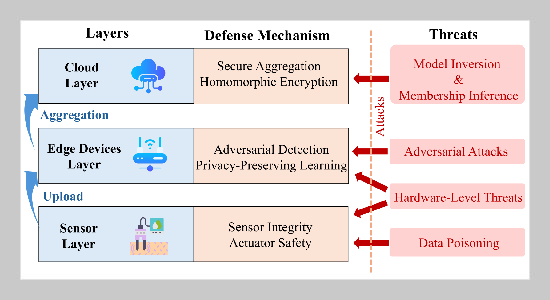
Consumer-grade Agricultural AIoT (Agri-AIoT) systems increasingly rely on cloud-based intelligence, which introduces latency, privacy, and connectivity limitations. These limitations are particularly severe for heterogeneous consumer devices operating under strict cost, energy, and computational constraints. This review advocates a shift from cloud-centric architectures toward distributed, edge-centric intelligence. We examine lightweight model compression techniques, including pruning, quantization, and knowledge distillation, that enable real-time and on-device decision-making. We further analyze security threats such as data poisoning and adversarial attacks that arise in decentralized agricultural systems. Privacy-preserving learning mechanisms, including Federated Learning, are discussed as key enablers of collaborative intelligence without raw data sharing. By integrating lightweight Artificial Intelligence techniques with AI-native networking principles, this paper provides a unified perspective on distributed intelligence in consumer Agri-AIoT ecosystems. We conclude that the convergence of these approaches is essential for building sustainable, secure, and self-adaptive consumer-grade agricultural electronics.
Keywords: AI-Native Networking; Resource-Constrained Devices; Agri-AIoT; Lightweight AI
[1] C. Zhao, J. Li, and X. Feng, (2021) “Development Strategy of Smart Agriculture for 2035 in China" Strategic Study of Chinese Academy of Engineering 23: 1–9.
[2] M. S. Farooq, S. Riaz, A. Abid, T. Umer, and Y. B. Zikria, (2020) “Role of IoT technology in agriculture: A systematic literature review" Electronics 9(2): 319. DOI: 10.3390/electronics9020319.
[3] V. K. Quy, N. V. Hau, D. V. Anh, N. M. Quy, N. T. Ban, S. Lanza, G.Randazzo,andA.Muzirafuti,(2022) “IoT-enabled smart agriculture: architecture, applications, and challenges" Applied Sciences 12(7): 3396. DOI: 10.3390/app12073396.
[4] B. Swaminathan, S. Palani, S. Vairavasundaram, K. Kotecha, and V. Kumar, (2023) “IoT-Driven Artificial Intelligence Technique for Fertilizer Recommendation Model" IEEE Consumer Electronics Magazine 12(2): 109–117. DOI: 10.1109/MCE.2022.3151325.
[5] D. Muhammed, E. Ahvar, S. Ahvar, M. Trocan, M.-J. Montpetit, and R. Ehsani, (2024) “Artificial Intelligence of Things (AIoT) for smart agriculture: A review of architectures, technologies and solutions" Journal of Net work and Computer Applications 228: 103905. DOI: 10.1016/j.jnca.2024.103905.
[6] L.-B. Chen, X.-R. Huang, G.-Z. Huang, and S.-Y. Kuo, (2025) “An Orchid Classification Scheme Using Deep Learning for Automated Packaging in Production Lines" IEEE Consumer Electronics Magazine 14(1): 65–76. DOI: 10.1109/MCE.2024.3434910.
[7] R. Dembani, I. Karvelas, N. A. Akbar, S. Rizou, D. Tegolo, and S. Fountas, (2025) “Agricultural data privacy and federated learning: A review of challenges and opportunities" Computers and Electronics in Agricul ture 232: 110048. DOI: 10.1016/j.compag.2025.110048.
[8] I. Sharma and V. Khullar, (2025) “Blockchain-enabled federated learning-based privacy preservation framework for secure IoT in precision agriculture" Journal of In dustrial Information Integration 44: 100765. DOI: 10.1016/j.jii.2024.100765.
[9] Q. Ding, X. Yue, Q. Zhang, Z. Xiong, J. Chang, and H. Zheng, (2024) “Bc2FL: Double-Layer Blockchain Driven Federated Learning Framework for Agricultural IoT" IEEE Internet of Things Journal: DOI: 10.1109/JIOT.2024.3485208.
[10] D. Das, V. Udutalapally, and S. P. Mohanty, (2021) “Consumer Technologies for Smart Agriculture" IEEE Consumer Electronics Magazine 10(4): 49–50.
[11] X. Yi, Z. Zheng, P. Wu, T. R. Gadekallu, and K. Fang, (2025) “Multi-Scale Tea Bud Grading Detection in Com plex Tea Garden Scenes Based on a GenAI Training Frame work"ComputersandElectronicsinAgriculture239: 111032. DOI: 10.1016/j.compag.2025.111032.
[12] M. Varol and M. ˙ Iskefiyeli, (2025) “A low cost compact network TAP device with Raspberry Pi 4" Engineering Science and Technology, an International Journal 70: 102118. DOI: 10.1016/j.jestch.2025.102118.
[13] S. Li, Z. Yuan, R. Peng, D. Leybourne, Q. Xue, Y. Li, and P. Yang, (2024) “An effective farmer-centred mobile intelligence solution using lightweight deep learning for integrated wheat pest management" Journal of In dustrial Information Integration 42: 100705. DOI: 10.1016/j.jii.2024.100705.
[14] P. Yu, F. Teng, W. Zhu, C. Shen, Z. Chen, and J. Song, (2025) “Cloud–edge–device collaborative computing in smart agriculture: Architectures, applications, and future perspectives" Frontiers in Plant Science 16: 1668545.
[15] A. Durrant, M. Markovic, D. Matthews, D. May, J. Enright, and G. Leontidis, (2022) “The role of cross-silo federated learning in facilitating data sharing in the agrifood sector" Computers and Electronics in Agriculture 193: 106648. DOI: 10.1016/j.compag.2021.106648.
[16] M. Aggarwal, V. Khullar, N. Goyal, and T. A. Prola, (2024) “Resource-efficient federated learning over IoAT for rice leaf disease classification" Computers and Elec tronics in Agriculture 221: 109001. DOI: 10.1016/j. compag.2024.109001.
[17] M. Chen, N. Shlezinger, H. V. Poor, Y. C. Eldar, and S. Cui, (2021) “Communication-efficient federated learning" Proceedings of the National Academy of Sciences 118(17): e2024789118. DOI: 10.1073/pnas.2024789118.
[18] M. Campoverde-Molina and S. Luján-Mora, (2025) “Cybersecurity in smart agriculture: A systematic literature review" Computers & Security 150: 104284. DOI: 10.1016/j.cose.2024.104284.
[19] Y. Gao, S. A. Camtepe, N. H. Sultan, H. T. Bui, A. Mahboubi, H. Aboutorab, M. Bewong, R. Islam, M. Z. Islam, A. Chauhan, et al., (2024) “Security threats to agricultural artificial intelligence: Position and perspective" Computers and Electronics in Agriculture 227: 109557. DOI: 10.1016/j.compag.2024.109557.
[20] Y. Chen, R. Li, Z. Zhao, C. Peng, J. Wu, E. Hossain, and H. Zhang, (2024) “NetGPT: An AI-native network architecture for provisioning beyond personalized generative services" IEEE Network 38(6): 404–413. DOI: 10.1109/MNET.2024.3376419.
We use cookies on this website to personalize content to improve your user experience and analyze our traffic. By using this site you agree to its use of cookies.