Wan NiuThis email address is being protected from spambots. You need JavaScript enabled to view it.
School of Electronics and Electrical Engineering, Zhengzhou University of Science and Technology, Zhengzhou 450064 China
Received: January 24, 2026 Accepted: March 5, 2026 Publication Date: March 27, 2026
Copyright The Author(s). This is an open access article distributed under the terms of the Creative Commons Attribution License (CC BY 4.0), which permits unrestricted use, distribution, and reproduction in any medium, provided the original author and source are cited.
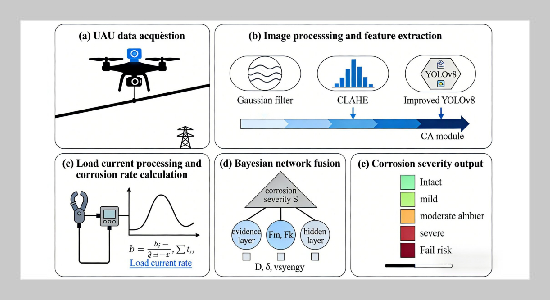
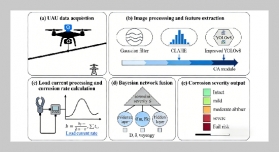
Overhead conductors are critical components of power transmission systems, and their corrosion-induced degradation poses severe threats to grid stability and operational safety. Traditional corrosion inspection methods rely on manual patrols or single-source data analysis, suffering from inefficiency, subjectivity, and limited accuracy in dynamic environments. To address these limitations, this paper proposes a real-time corrosion estimation framework for overhead conductors by fusing UAV-acquired RGB images and load current data. First, an improved YOLOv8 model integrated with a Coordinate Attention (CA) module is designed to segment corroded regions from RGB images, enabling quantitative extraction of corrosion features (e.g., rust layer fractal dimension, crack density). Second, a physics-informed corrosion rate model is established to characterize the synergistic effect of load current and environmental factors, based on Faraday’s electrolysis law and corrosion electrochemistry theory. Third, a Bayesian network-based data fusion strategy is developed to integrate image-derived features and current-based corrosion rates, realizing accurate estimation of corrosion severity (intact, mild, moderate, severe, failure risk). Experiments are conducted on a 110kV transmission line segment in an industrial polluted area, where 21026 UAV RGB images and 3 months of load current data are collected. The results demonstrate that the proposed framework achieves a corrosion severity classification accuracy of 92.3% outperforming single-source methods and state-of-the-art fusion models. The inference speed reaches 28FPS, satisfying real-time inspection requirements. This study provides a reliable technical solution for intelligent corrosion monitoring of overhead conductors, supporting data-driven power grid maintenance decisions.
[1] A. U. Mahin, S. N. Islam, F. Ahmed, and M. F. Hos sain, (2022) “Measurement and monitoring of overhead transmission line sag in smart grid: A review" IET generation, transmission & distribution 16(1): 1–18. DOI: 10.1049/gtd2.12271.
[2] Z. Yang, N. Zivlak, M. Xu, and M. Ljubicic, (2016) “Study on overhead transmission line on-line monitoring technology" Thermal Science 20(suppl. 2): 383–391. DOI: 10.2298/TSCI151214024Y.
[3] V. S. Saji, (2023) “Corrosion and materials degradation in electrochemical energy storage and conversion devices" Chem Electro Chem 10(11): e202300136. DOI: 10.1002/celc.202300136.
[4] M. Ahmadi, O. Adeleye, G. Vonalt, and M. Nazemi, (2025) “Identifying sweet spots for redox reactions in electrochemical advanced oxidation and reduction processes for pollutant degradation and resource recovery" Environ mental Science & Technology 59(34): 17952–17977. DOI: 10.1021/acs.est.5c04748.
[5] R. E. Melchers, R. Jeffrey, I. A. Chaves, and R. B. Petersen, (2025) “Predicting corrosion for life estimation of ocean and coastal steel infrastructure" Materials and Corrosion 76(6): 776–789. DOI: 10.1002/maco.202314201.
[6] J. C. Wang, M. P. Jung, S. Yin, and H. Li, (2025) “Adaptive Multi-Scale Gated Convolution and Context-Aware Attention Network for Accurate Small Object Detection" International Journal of Computational Methods and Experimental Measurements 13(3): 576–587. DOI: 10.56578/ijcmem130308.
[7] Z. Zhou, X. Yu, P. Gardoni, K. Ji, and D. Lu, (2025) “Seismic risk estimates for reinforced concrete structures with incorporation of corrosion and aftershock" Reliability Engineering & System Safety 254: 110585. DOI: 10.1016/j.ress.2024.110585.
[8] S. Yin, H. Li, A. A. Laghari, L. Teng, T. R. Gadekallu, and A. Almadhor, (2024) “FLSN-MVO: edge computing and privacy protection based on federated learning Siamese network with multi-verse optimization algorithm for industry 5.0" IEEE Open Journal of the Communications Society 6: 3443–3458. DOI: 10.1109/OJCOMS. 2024.3520562.
[9] J. He, Y. Wang, Y. Wang, R. Li, D. Zhang, and Z. Zheng, (2024) “A lightweight road crack detection algorithm based on improved YOLOv7 model" Signal, image and video processing 18(Suppl 1): 847–860. DOI: 10.1007/s11760-024-03197-y.
[10] Y. Xiao, Y. Du, D. Tang, L. Ou, H. Sun, and Y. Lu, (2018) “Study on the influence of environmental factors on AC corrosion behavior and its mechanism" Materials and corrosion 69(5): 601–613. DOI: 10.1002/maco.201709843.
[11] F. Salgueiro, M. Ribeiro, A. Carvalho, G. Covas, Ø. Baltzersen, and C. S. Proença, (2024) “Monitoring of Wall Thickness to Predict Corrosion in Marine Environments Using Ultrasonic Transducers" NDT 2(3): 255 269. DOI: 10.3390/ndt2030016.
[12] G. Yadav, S. Maheshwari, and A. Agarwal. “Contrast limited adaptive histogram equalization based enhancement for real time video system”. In: 2014 international conference on advances in computing, communications and informatics (ICACCI). IEEE. 2014, 2392 2397. DOI: 10.1109/ICACCI.2014.6968381.
[13] J. Rajput, N. L. Kushwaha, A. Srivastava, D. K. Vishwakarma, A. Mishra, P. Sahoo, T. Suna, L. Rana, M. S. Jatav, J. Kumar, et al., (2025) “Developing machine learning models for predicting daily relative humidity and solar radiation using lagged time series data inputs in a semi-arid climate" Journal of Atmospheric and Solar-Terrestrial Physics 276: 106619. DOI: 10.1016/j.jastp.2025.106619.
[14] T. Griffiths, Z. X. Conti, J. Hidalgo-Salaverri, and M. Bluck, (2024) “Using Bayesian networks as meta models for predicting uncertain fusion economics in spherical tokamaks" IEEE Transactions on Plasma Science 52(9): 3953–3959. DOI: 10.1109/TPS.2024.3359761.
[15] H. Chen, Y. Cao, S. Cao, and H. Piao, (2025) “A Study of Corrosion-Grade Recognition on Metal Surfaces Based on Improved YOLOv8 Model" Sensors 25(8): 2630. DOI: 10.3390/s25082630.
[16] J. Zhang, R. Zhang, F. Luan, and H. Zhang, (2025) “PerMSCA-YOLO:aperceptualmulti-scale convolutional attention enhanced YOLOv8 model for rail defect detection" Applied Sciences 15(7): 3588. DOI: 10.3390/ app15073588.
[17] J. Jiang, X. Wan, F. Zhu, D. Xiang, Z. Hu, and S. Mu, (2025) “A deep learning framework integrating Trans former and LSTM architectures for pipeline corrosion rate forecasting" Computers & Chemical Engineering: 109365. DOI: 10.1016/j.compchemeng.2025.109365.
We use cookies on this website to personalize content to improve your user experience and analyze our traffic. By using this site you agree to its use of cookies.